Behavioral compensation preserves collective behavior when individual members are compromised

Behavioral compensation preserves collective behavior when individual members are compromised
Nguyen, J. B.; Lambert, C. E.; Cook, C. N.
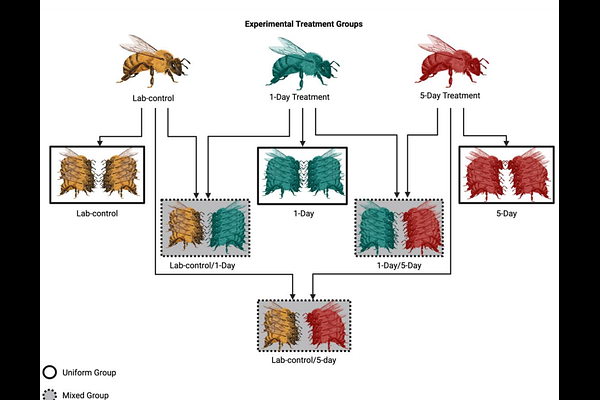
AbstractCollective behavior in animal societies can buffer individual costs and confer resilience to environmental challenges. However, the mechanisms by which groups sustain function when members are compromised remain poorly understood. In the presented study, we investigate how social context shapes collective fanning, a thermoregulatory behavior critical for colony function, in Western honeybees (Apis mellifera). Using oxytetracycline (OTC), a known physiologically disruptive antibiotic to honeybees, to selectively impair certain group members, we tested our hypothesis that the presence of untreated bees would rescue the fanning response in mixed-composition groups. We show that groups containing untreated individuals fan at levels comparable to fully untreated groups, despite the presence of OTC-impaired bees. This preservation of collective thermoregulatory function was correlated with both treated and untreated individuals in mixed groups shifting their interaction dynamics and social network positions. These findings reveal a decentralized mechanism of collective resilience, whereby behavioral compensation by individuals sustains group-level thermoregulation under partial disruption. Our results provide a framework for understanding how social insect colonies maintain function in the face of individual-level perturbations, with broader implications for predicting the limits of collective resilience in animal societies experiencing increasing environmental pressures.