Airway Diameter-Matched Injury Improves Severity and Reproducibility of Experimental Rabbit Tracheal Stenosis

Airway Diameter-Matched Injury Improves Severity and Reproducibility of Experimental Rabbit Tracheal Stenosis
Laitman, B. M.; Ong, C.; Becker, O.; Anderson, B.; Randall, G. W.; Gonzalez, D.; Reddy, N.; Chen, Y.-W.
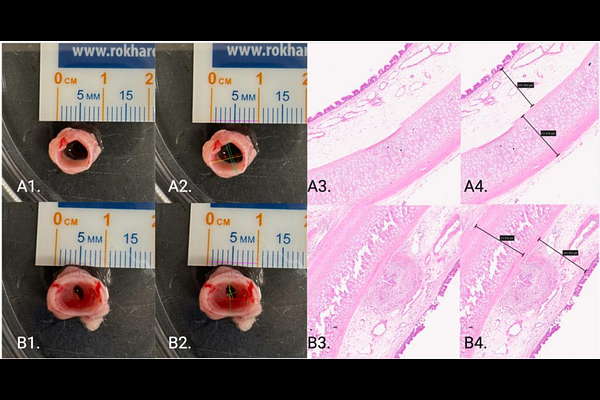
AbstractObjective Reliable animal models of tracheal stenosis are necessary for the development and translational testing of anti-fibrotic and regenerative therapies, but existing rabbit models frequently demonstrate substantial variability in stenosis severity, which limits their translational utility. The objective of our study was to determine whether airway diameter-matched mechanical injury improves the severity and reproducibility of experimental tracheal stenosis in a rabbit model, and to evaluate whether rabbit body weight is a reliable surrogate for tracheal luminal diameter during model creation. Methods Fourteen male New Zealand White rabbits (weight range, 2.7-3.5 kg) underwent tracheal injury using steel-bristle brushes introduced through a tracheotomy. Animals were assigned to receive either airway diameter-matched injury, in which brush size was selected to closely approximate the directly measured tracheal lumen diameter, or non-matched injury, in which brush size was selected without regard to measured lumen diameter. At postoperative day 21 (POD21), the injured tracheal segment and a native uninjured segment from the same animal were harvested and compared. Stenosis degree was quantified grossly, and lamina propria-to-cartilage (LP:C) ratio was quantified histologically by three blinded reviewers. The relationship between rabbit weight and airway diameter was assessed, and inter-rater reliability was calculated using the intraclass correlation coefficient (ICC). Results Twelve of fourteen rabbits reached the POD21 endpoint; two were euthanized early for severe airway compromise meeting humane endpoint criteria, both with approximately 80% stenosis. Injured tracheas demonstrated significantly greater stenosis than native controls (66.0 {+/-} 13.0% vs 16.0 {+/-} 2.7%; p = 0.00012), with a corresponding increase in LP:C ratio (p = 0.031). Airway diameter-matched injury produced significantly greater stenosis than non-matched injury (74.6 {+/-} 6.1% vs 50.6 {+/-} 4.0%; p = 0.001), while LP:C ratio did not differ between injury techniques (p = 1.0). Rabbit weight did not correlate with airway diameter (r = 0.176, p = 0.515; R^2= 0.031). Inter-rater reliability was excellent for both stenosis degree (ICC = 0.989) and LP:C ratio (ICC = 0.992). Conclusions Direct measurement and matching of injury instrument diameter to native airway diameter substantially improves both the severity and the reproducibility of stenosis in a rabbit tracheal injury model, whereas body weight is an unreliable surrogate for airway size. This optimized, standardized protocol offers a reproducible platform for future translational studies of airway fibrosis and anti-fibrotic or regenerative therapies.