Mechanochemical Feedback between Cell Shape and Intracellular Mechanics Revealed by a Finite-Element Framework

Mechanochemical Feedback between Cell Shape and Intracellular Mechanics Revealed by a Finite-Element Framework
Contri, A.; Francis, E. A.; Massing, A.; Rangamani, P.
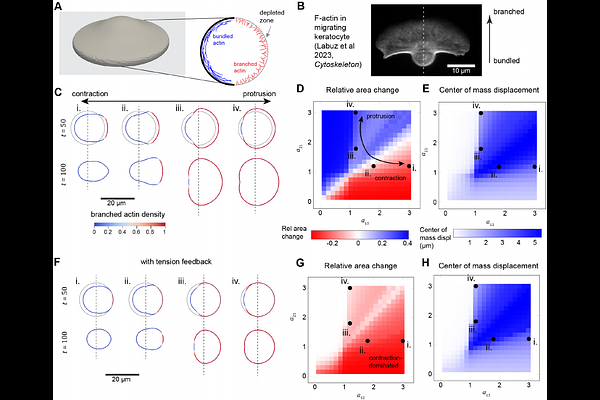
AbstractCell shape and mechanics are intricately connected and tightly regulated by mechanochemical events including biochemical signaling, cytoskeletal remodeling, and plasma membrane mechanics. While experimental advances in microscopy have shed light on the intricate coordination involved in cell shape change in response to different cues, the ability to conduct three-dimensional simulations in realistic geometries remains an open computational challenge. In this work, we develop a finite-element framework that incorporates advection-diffusion-reaction equations coupled with equations governing the kinematics of a deformable interface representing the cell membrane. We applied this framework to three distinct coupled mechanochemical systems, each governed by geometric partial differential equations, resulting in large deformations of the interface. In all three examples, our simulations revealed the emergence of feedback between cellular signaling, cytoskeletal organization, and cell shape. In our first two sets of simulations, we observed that cell migration and neutrophil protrusion were regulated by membrane tension-mediated feedback. In our final application, we predicted shape changes of a dendritic spine starting from a realistic geometry, and found that the complex shape of the spine gives rise to localized regimes of actin cytoskeleton remodeling not previously observed with idealized geometries. Thus, our finite-element framework allows us to generate new mechanistic insights for biophysical problems.