De Novo Regeneration of Rete Ridges during Cetacean skin wound healing

De Novo Regeneration of Rete Ridges during Cetacean skin wound healing
Liu, T.-Y.; Wang, H.-V.; Yang, W.-C.; Yang, C.-C.; Su, C.-Y.; Chiou, Y.-T.; Chiou, T.-H.; Shieh, S.-J.; Tang, M.-J.; Chuong, C. M.; Hughes, M. W.
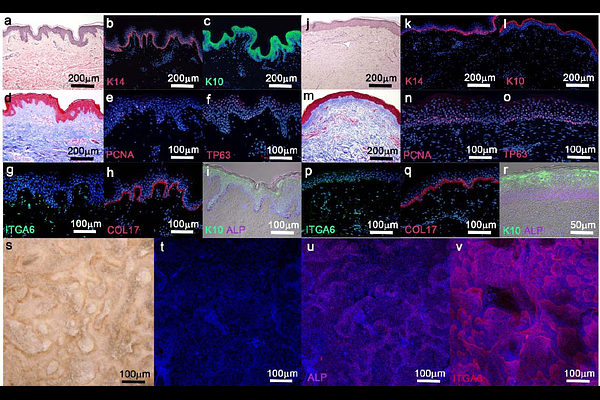
AbstractHumans are tight-skinned mammals who typically fail to regenerate large full-thickness skin wounds, instead healing with substantial scarring and concomitant loss of function. Mechanical context is a major determinant of this outcome: elevated tissue tension or stiffness promotes fibrotic repair associated with hypertrophic or keloid scarring. Accordingly, regenerative medicine research has relied on diverse animal models to understand scar development and skin regeneration. Loose-skinned mammals exhibit greater regeneration ability. Furthermore, spiny mouse skin is significantly less stiff and associated with enhanced regenerative ability. Interestingly, this skin wound stiffness can be modulated to shift healing toward more regenerative or more fibrotic trajectories. Despite of this progress, the restoration of normal skin architecture after large-full thickness injury has not been elucidated in tight-skinned mammals. Can large full-thickness wounds regenerate with minimal scarring in tight-skinned mammals? Here we show the tight-skinned mammal Fraser's Dolphin regenerates de novo a complex rete ridge architecture with associated vasculature and minimal scar following large full-thickness wound healing. Counterintuitively, this skin regeneration occurs in an aqueous, high-shear stress and high-tension environment. Complete rete ridge regeneration in tight-skinned mammals has not been documented and not observed in humans except in utero. This unique ability to rebuild elaborate rete ridges under tension is an opportunity to uncover molecular, cellular, and tissue-level mechanisms that enable regenerative wound healing in a mechanical regime typically associated with fibrosis.