A supervised digital game intervention supports language and communication in young children.

A supervised digital game intervention supports language and communication in young children.
Pena, M.; Dehaene-Lambertz, G.; Pino, E.; Pittaluga, E.; Cortes, P.; de la Riva, C.; Palacios, O.; Guevara, P.
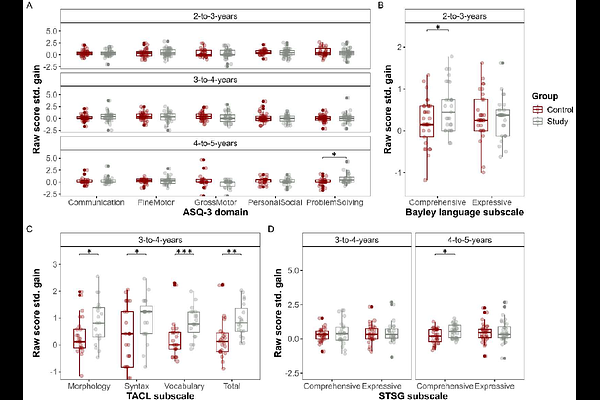
AbstractThe role of digital media in early childhood development remains highly debated, particularly regarding its impact on language acquisition. While excessive or unsupervised screen exposure has been linked to poorer outcomes, less is known about whether structured and interactive uses of technology can support learning. Building on previous research, we evaluated a brief, educator-supervised tablet-based intervention in 246 children aged 2-5 years from low- to middle-socioeconomic backgrounds attending public early education centers. Using a pre-post design with matched study and control groups, children completed 4-8 short training sessions (15 minutes each) involving interactive word-image associations spanning multiple linguistic categories. Preschoolers additionally engaged in prompted vocalization. Across age groups (2-3, 3-4, and 4-5 years), children in the intervention showed greater gains in language comprehension than controls, including receptive language in toddlers ({beta} = 0.49, p = 0.009), vocabulary and morphology in younger preschoolers ({beta} = 0.59-0.68, all p < 0.05), and grammar comprehension in older preschoolers ({beta} = 0.30, p = 0.038). These effects were consistent after accounting for child and parental characteristics. Together, these findings suggest that the developmental impact of digital media depends less on exposure itself than on how it is used. When embedded in structured, socially guided interactions, even brief tablet-based activities may support early language development.