Actin nucleation promoting factors drive Arp2/3 dependent endosomal microautophagy

Actin nucleation promoting factors drive Arp2/3 dependent endosomal microautophagy
Surabhi, S.; Jenny, A.
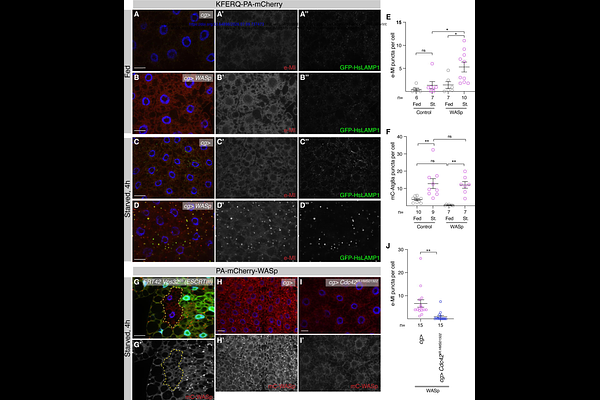
AbstractAutophagy is a catabolic process that degrades damaged organelles and aggregation-prone proteins and plays key roles during development and in maintaining cellular homeostasis. It can be induced by stress including starvation, oxidative stress, or accumulation of misfolded proteins. Autophagy declines with age and there is great interest in manipulating autophagy to improve neurodegenerative diseases, as its stimulation shows promise to improve diseases including Huntington, Alzheimer, and Parkinson. Endosomal microautophagy (e-MI) is a type of autophagy in which cytosolic proteins are delivered to late endosomes and degraded upon incorporation into intraluminal vesicles of multivesicular bodies. Here, we report that the actin nucleation-promoting factors (NPFs) known to activate the Arp2/3 complex to promote branched actin assembly can alter the dynamics of e-MI. We found that upon stress exposure, overexpression of the NPFs WASp, Wash, or SCAR results in an expedited induction of e-MI. Strikingly, Wash is uniquely required for physiological e-MI induction implying that NPFs are not functionally redundant for e-MI. We show that the WASH complex regulates e-MI on late endosomes acting via Arp2/3 and thus likely branched actin. Surprisingly, the regulation of e-MI by Wash is independent of retromer that is known to recruit Wash to early endosomes for its role in recycling of membrane proteins and rather reflects a novel degradative aspect of Wash function. Taken together, we identified a novel function of NPFs as upstream regulators of e-MI that could be used to activate e-MI ectopically to improve aggregate clearance during neurodegeneration.