MeV Electrophilic Axion-like Particles from Sun

MeV Electrophilic Axion-like Particles from Sun
Shao-Feng Ge, Sk Jeesun, Tao Li
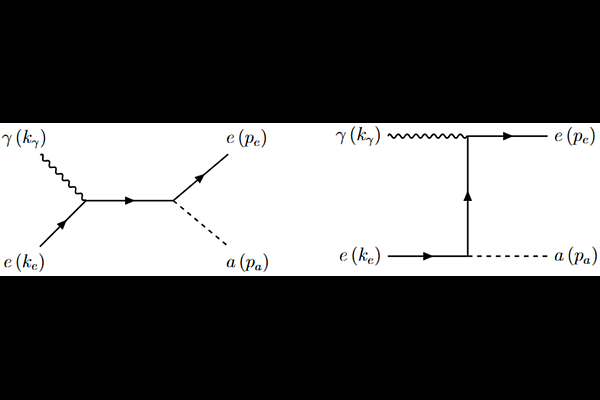
AbstractThis work explores the production of an MeV-scale electrophilic axion-like particles (ALPs) by utilizing the monochromatic 5.5MeV photon resulting from the nuclear fusion processes in the Sun. These 5.5MeV photons can undergo the Compton-like scattering with the ambient electrons in the solar matter to produce a substantial flux of MeV ALPs. Upon reaching the Earth, such ALPs can be detected via the same electron coupling, offering a new opportunity for the dark matter (DM) direct detection experiments to probe the previously unexplored parameter regions. We show that the existing data of LZ, PandaX-4T, and Borexino can attain the sensitivities $g_{ae} \lesssim 3.7 \times 10^{-6}$, $g_{ae} \lesssim 3.7 \times 10^{-6}$ and $g_{ae} \lesssim 1.7 \times 10^{-6}$, respectively, for $m_a \lesssim 1$MeV. An optimistic 200 tonne$\times$year exposure by PandaX-xT can reach $g_{ae}\lesssim 1.6 \times 10^{-6}$ for most of the mass window $m_a < 1$MeV and even $g_{ae} \lesssim 1.5 \times 10^{-7}$ with $m_a$ approaching 1MeV. Despite the stringent constraints from different laboratory experiments and astrophysical observations, our obtained limits from LZ, PandaX-4T, and Borexino can probe new parameter regions, specifically in the mass window $0.4\,{\rm MeV} \lesssim m_a \lesssim 1$MeV.