The neuronal clock network in the polar key species Antarctic krill (Euphausia superba)

The neuronal clock network in the polar key species Antarctic krill (Euphausia superba)
Hüppe, L.; Reinhard, N.; Karl, A.; Kirsch, V.; Wollny, L.; Palmer, A.; Rieger, D.; Senthilan, P. R.; Helfrich-Förster, C.
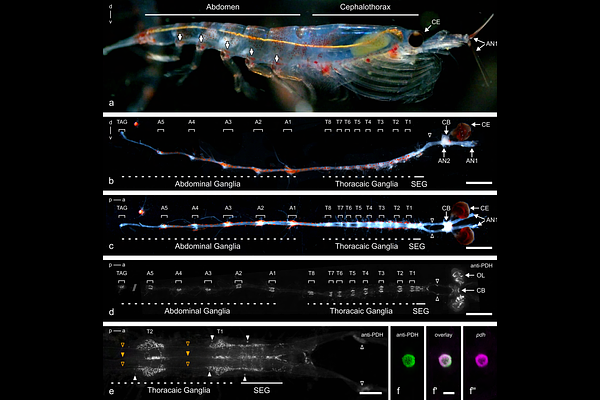
AbstractOrganisms are exposed to predictable daily and seasonal environmental oscillations. Biological clocks enable organisms to anticipate these changes and coordinate physiology and behaviour accordingly. While circadian mechanisms are well studied in terrestrial model organisms, little is known about the neuronal organisation of biological clocks in ecologically important species, especially in the marine environment. Antarctic krill (Euphausia superba) is central to the functioning of the Southern Ocean ecosystem and relies on precise timing to cope with the extreme, high-latitude fluctuations in photoperiod, food availability, and sea-ice cover in its habitat. Despite evidence for circadian and seasonal rhythms in krill behaviour and physiology, the neuronal architecture underlying these timing processes has remained unresolved. In this study, we use in situ hybridisation and antibody staining to characterise the circadian clock in the krill brain. Immunostaining with an antibody against crustacean {beta}-Pigment-dispersing hormone ({beta}-PDH) reveals distinct clusters of PDH-positive neurons in the optic lobes and dorsal central brain, along with an extensive PDH-positive fibre network. We further localise transcripts of the core clock genes cryptochrome-2 (cry2) and period (per) in cell clusters in the optic lobes, which also include the PDH-positive neurons. More specifically, PDH-positive neurons are a subgroup of the cry2 and per-positive cells. Together, these findings provide the first description of the neuronal architecture of the circadian clock in Antarctic krill and establish essential groundwork for future studies on biological timing, environmental adaptation, and the resilience of this key species in a rapidly changing Southern Ocean.