Polyvinylpyrrolidone enhances AAV transduction in vitro and shows preliminary utility for subretinal delivery

Polyvinylpyrrolidone enhances AAV transduction in vitro and shows preliminary utility for subretinal delivery
Gogoleva, N.; Tran, T.-H.; Oki, M.; Fukuda, S.; Shahri, Z. J.; Kumaga, E.; Takahashi, S.; Hamada, M.
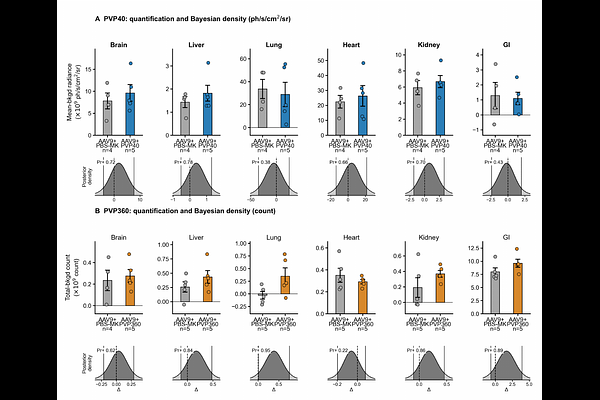
AbstractAdeno-associated virus (AAV) vectors are widely used for gene delivery, but inefficient transduction can require high vector doses. We tested whether unmodified linear polyvinylpyrrolidone (PVP), a pharmaceutical excipient, can improve AAV formulation without chemical modification of the vector or polymer. PVP10, PVP40, and PVP360 were evaluated in vitro across HEK293, HeLa, MEF, and CHO cells; selected formulations were tested after intravenous delivery, and 3% PVP40 was tested by subretinal delivery. In vitro, 1-3% PVP increased AAV8- and AAV9-mediated GFP expression across multiple cell lines. PVP360 showed broad activity in the initial cross-cell assay, whereas the HEK293 molecular-weight screen identified PVP40 and PVP360 as the most active formulations. The substantial fold increase observed in CHO cells largely reflected the low baseline transduction of the control group. MTT absorbance declined with concentrated PVP360, whereas PVP40 retained transduction-enhancing activity and was selected for local testing. In the HeLa AAV-DJ assay, the response pattern differed between MOI 1,000 and MOI 100; the largest observed increases in GFP-positive area occurred with 1.5% PVP10 and 1.5% PVP360 at MOI 100. Intravenous AAV9 delivery with PVP did not consistently increase ex vivo organ reporter signal. By contrast, subretinal delivery of AAV-PHP.eB with 3% PVP40 produced a 1.79-fold larger mean DsRed-positive area per retinal section, averaged within each eye (Welch's t-test p = 0.063; Bayesian Pr[{Delta} > 0] = 0.952). These findings support further evaluation of PVP40 for local subretinal AAV delivery.