Netrin-1 Acts as a Guardian of Naive Pluripotency in Human Embryonic Stem Cells

Netrin-1 Acts as a Guardian of Naive Pluripotency in Human Embryonic Stem Cells
De Neufville, A.; Masfaraud, E.; Alfeghaly, C.; Stoeckl, J. B.; Doerflinger, N.; Marcy, G.; Rognard, C.; OSTEIL, P.; Lantelme, M.; Lavial, F.; Chazaud, C.; Frohlich, T.; Savatier, P.; Aksoy, I.
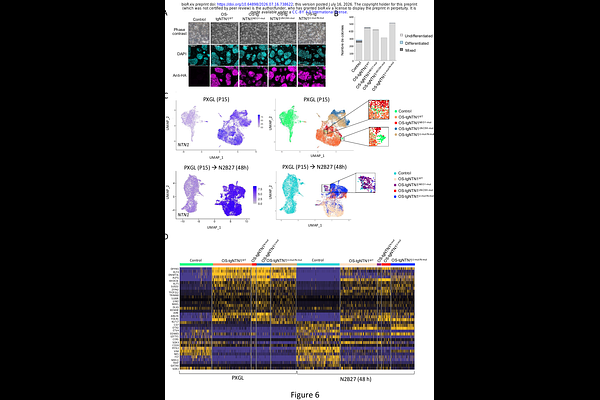
AbstractWe investigated the role of Netrin-1 (NTN1) in human naive pluripotency using complementary loss- and gain-of-function approaches. In primate embryos and human embryonic stem cells (hESCs), Netrin-1 expression is associated with the naive pluripotent state. Disruption of NTN1 had no detectable effect on hESCs maintained on murine embryonic fibroblasts. However, under sub-optimal culture conditions, NTN1-knockout cells exhibited compromised naive pluripotency, which was rescued with feeder cells overexpressing Netrin-1. Netrin-1 overexpression in hESCs accelerated acquisition of the naive state and markedly increased resistance to differentiation. These effects were accompanied by extensive epigenetic remodeling, including H3K27ac and H2K27me3. Proteomic and phospho-proteomic analyses further revealed rapid Netrin-1-dependent alterations in pathways controlling cell adhesion, signaling, and chromatin regulation. Together, these findings extend the role of Netrin-1 beyond its established functions and identify it as a coordinator of extracellular cues, intracellular signaling, and nuclear regulatory mechanisms that support human naive pluripotency.