From local motifs to global dynamical stability in the mouse brain connectome

From local motifs to global dynamical stability in the mouse brain connectome
liu, y.; wei, y.; Peng, H.
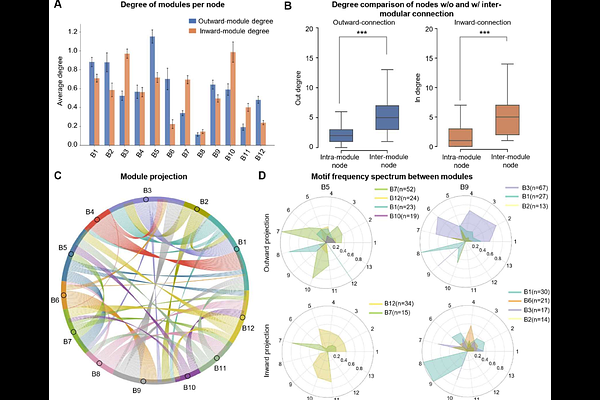
AbstractBrain connectomics provides insights into the architectural organization of neural circuits across the brain. But it remains unclear how neurons and their connections give rise to brain-wide activity. Here, using a sparse detailed mouse brain connection map called "bouton-net," we studied how specific neuron patterns (motifs) and groups (modules) affect information processing. We discovered that complex, "two-way" connections are much more common than expected. These patterns appear across all brain regions, suggesting they are a universal rule for brain wiring. We also found that different brain modules do not communicate randomly; instead, they talk through a small group of highly connected neurons. By testing these organization patterns with computer models, we found that the brain may not be wired for the best memory capacity or nonlinear processing capability, but to ensure that capability remains stable. This structure provides the foundation for a reliable, "crash-proof" biological network.