Progranulin haploinsufficiency remodels the cerebral microvasculature and neurovascular unit

Progranulin haploinsufficiency remodels the cerebral microvasculature and neurovascular unit
Chakraborty, S.; Weick, M.; Franciosa, S. A.; Tabrizi, Z.; Swinehart, C.; Rodriguez Moore, G.; Lee, D.; Bhatt, N. N.; Cano, A.; Poorva, P.; Torices, S.; Rust, R.; Bracko, O.
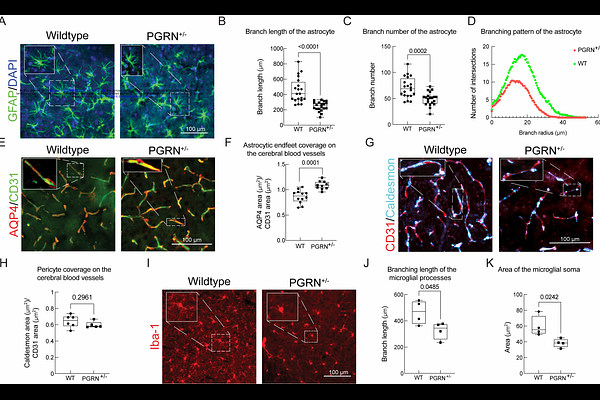
AbstractProgranulin (PGRN) deficiency is a major genetic cause of frontotemporal dementia (FTD), yet its impact on cerebrovascular function remains understudied. Here, we show that PGRN deficiency contributes to cerebral microvascular perfusion and induces alterations within the neurovascular unit. In vivo two-photon imaging revealed increased capillary stalling and reductions in cerebral blood flow (CBF), driven in part by increased leucocyte-capillary interactions and elevated endothelial ICAM-1 expression. Transcriptomic profiling of isolated cerebral microvessels demonstrated coordinated upregulation of immune and extracellular matrix pathways alongside suppression of angiogenic and stress-response programs, indicative of endothelial activation. Cross-species analyses identified partial conservation of these vascular signatures in endothelial cells from human FTD-GRN patients, associated with dysregulated angiogenic and inflammatory signaling. Despite altered tight junction organization and reduced solute carrier transporter expression, blood-brain barrier (BBB) permeability remained largely intact, suggesting functional rather than structural BBB disruption, as well as. These vascular changes were accompanied by broad alterations in the morphology of astrocytes, pericytes, and microglial cells. Here we determined a novel role for progranulin in cerebrovascular homeostasis and established