Dynamic genomes uncover opposite sex determination in the invasive quagga and zebra mussels

Dynamic genomes uncover opposite sex determination in the invasive quagga and zebra mussels
Weber, A. A.-T.; Uthanumallian, K.; Kocot, K. M.; Giulio, M.; Signorini, S. G.; Senut, M.-C.; Chen, Z.; Sigwart, J.; Passamaneck, Y.
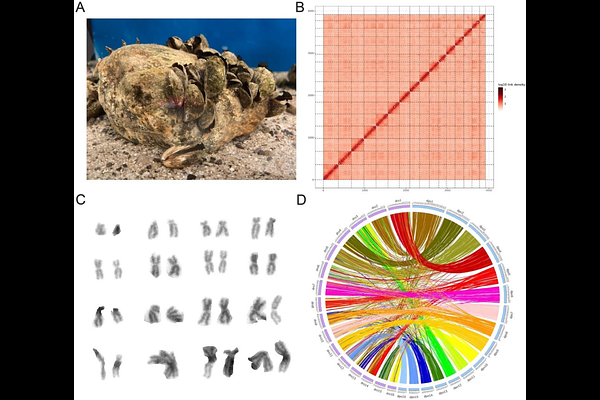
AbstractSex determination (SD) in zebra and quagga mussels, two globally invasive freshwater bivalves responsible for major ecological and economic impacts, has remained unexplored. Using chromosome-scale genomes and whole-genome resequencing of 80 individuals, we uncover strikingly different SD architectures: zebra mussels exhibit a polygenic ZZ ZW system, with FoxL2 among the prominent female-associated candidates. In contrast, quagga mussels carry a highly localized ~800 kb XX XY SD region containing FoxL2-Y, a novel candidate male-determining locus that arose through duplication and divergence of FoxL2. K-mer analyses and staged embryonic transcriptomes reveal rare but specific FoxL2-Y expression consistent with an early regulatory role in male determination. The quagga mussel SD region is also enriched for C-lectins, a gene family implicated in gamete-interaction processes, supporting a model in which haploid selection facilitated SD turnover. These findings reveal unexpected SD divergence between closely related species and illuminate mechanisms enabling rapid evolution of reproductive systems in invasive taxa.