Sol-gel Transition Drives Hyper-fast Mixing in a Giant Cell

Sol-gel Transition Drives Hyper-fast Mixing in a Giant Cell
Diaz, U.; Das, M. F.; Thukral, S.; Abuel, J.; Carter, M.; Marino, A.; Galvan, L.; Irungu, A.; Leiva, J.; Ballor, A.; Marshall, W. F.
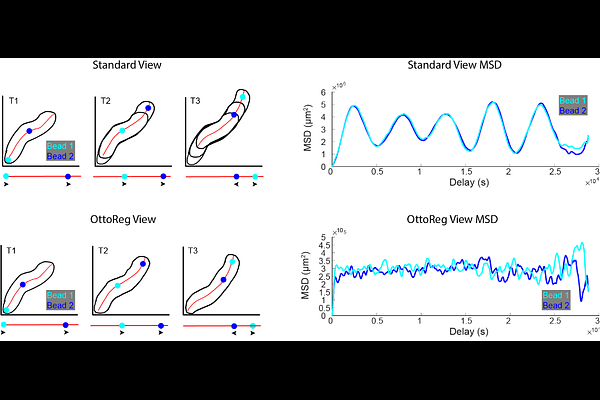
AbstractThe cytoplasm is a crowded and dynamic fluid within which cellular building blocks such as mRNA, proteins, or organelles undergo transport and mixing. Although small things like proteins can eventually mix through diffusion, the high viscosity of cytoplasm means that it should be difficult to obtain significant mixing for structures in the size range of mRNA, multi-protein complexes or organelles. In large amoeboid cells, the cytoplasm undergoes active streaming coupled to cell motility, but this streaming is laminar flow which should not be effective for mixing. In this work we used a combination of live cell tracking of injected beads and computational analysis of motion and mixing in giant amoeba Chaos carolinensis with the initial goal of testing the possibility that large-scale cellular deformations during pseudopod formation might implement chaotic mixing by a Baker-transform like process. Instead, we found that Chaos carolinensis accelerates cytoplasmic mixing using a novel cytoplasmic gel state capture and release strategy. While it was previously thought that the amoeba sol to gel state transitions only occur at the trailing and leading edge of the cell body, our work indicates that these transitions occur frequently throughout the mid-cell region, driving the cytoplasmic mixing of beads and organelles. These results indicate that amoeba achieves nearly complete mixing between 1 and 2 cytoplasmic stream/flow cycle, effectively approximating the Bernoulli mixing regime and thus representing one of the theoretically fastest possible mixers.