Validation of tissue-specific RNAi systems in C. elegans reveals a converging role for polyubiquitin UBQ-1/UBC in vitellogenin metabolism and lifespan

Validation of tissue-specific RNAi systems in C. elegans reveals a converging role for polyubiquitin UBQ-1/UBC in vitellogenin metabolism and lifespan
da Silva, N. S. M.; Bolonyi, C.; Ouellette, A.; Harrison, L.; Kim, S. Y.; Daigle, S.; Doucet, S. T.; Lapierre, L. R.
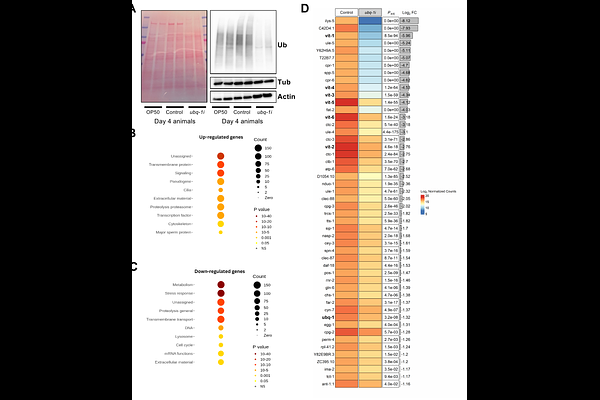
AbstractNumerous studies in C. elegans have taken advantage of gene silencing RNAi libraries and tissue-specific RNAi systems to temporally and spatially understand gene function. Tissue-specific RNAi strains were created via tissue-specific functional expression of a key gene in the RNAi system in a presumably RNAi insensitive correspondingly-mutated background. Here, we tested the level of RNAi insensitivity across different commonly used RNAi-defective mutants (rde-1 and sid-1) using lifespan analyses. Remarkably, while we found similarly important lifespan shortening in wild-type animals by silencing the polyubiquitin gene ubq-1 (UBC) at both 20{degrees}C and 25{degrees}C, we found wide and temperature-sensitive variations in RNAi sensitivity across different rde-1 and sid-1 strains from substantial sensitivity to complete insensitivity. This riveting finding warrants a re-evaluation of the tissue-specific interpretations in numerous tissue-specific RNAi studies in C. elegans. Using validated tissue-specific RNAi systems, we determined that proteasomal burden largely differs between the germline and the soma. Notably, gonadally-accumulating vitellogenin proteins substantially contributed to the total polyubiquitinated proteins observed during aging. Interestingly, we found that UBQ-1 was essential to maintain the transcription of highly expressed genes, including vitellogenins, supporting a broad and key role for polyubiquitin beyond proteostasis. Altogether, we authenticated commonly used tissue-specific RNAi systems and uncovered a new approach to improve RNAi insensitivity in RNAi-defective strains. With validated tissue-specific RNAi strains, we spatially analyzed proteasomal function and age-related polyubiquitinated protein accumulation, and revealed a converging regulatory link between UBQ-1, vitellogenin metabolism and lifespan in C. elegans.