Critical Process Steps for Mechanical Agitation Driven Coated Nanobubble Self Assembly

Critical Process Steps for Mechanical Agitation Driven Coated Nanobubble Self Assembly
Kosmides, T.; Wegierak, D.; Khan, A. H.; Bederman, I.; Kim, T. K. J.; Exner, A. A.
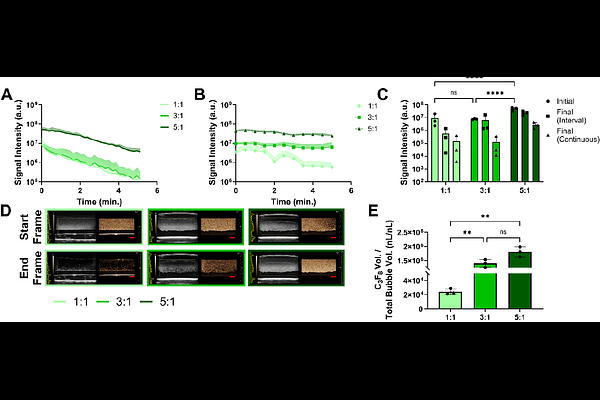
AbstractThe term nanobubble (NB) includes a wide range of gas core, submicron particles. A subgroup of NBs consists of phospholipid-shelled (or coated) nanoparticles stabilizing a perfluorocarbon gas core which have gained recent interest as ultrasound (US) contrast agents. Several methods are available to produce coated NBs. Among these, amalgamation driven self-assembly has been the most utilized. Amalgamation (also referred to as mechanical agitation) is a simple technique currently used for production of commercial and clinically relevant microbubble suspensions. When combined with size-isolation steps, it can also generate submicron NB suspensions with a narrow size distribution. While this technique has been used extensively, no prior work has systematically examined the critical manufacturing parameters needed to produce the optimal coated NB formulation. In this work, we investigate how precursor lipid dispersion, perfluorocarbon gas to lipid ratio, and pressurized size isolation affect the formation and size isolation of stable, uniform NBs. Results show that the precursor lipid dispersions exhibiting a monomodal size distribution produced the most stable NBs. Additionally, perfluorocarbon volume in excess of lipid dispersion volume is required to form high concentration, stable NBs. Finally, pressurized size isolation resulted in high concentration, US stable NBs. These findings establish the understanding of the key process parameters which affect uniform size and stable NB production via mechanical amalgamation.