Quantum Tilted Loss in Variational Optimization: Theory and Applications

Quantum Tilted Loss in Variational Optimization: Theory and Applications
Yixian Qiu, Josep Lumbreras, Xiufan Li, Patrick Rebentrost
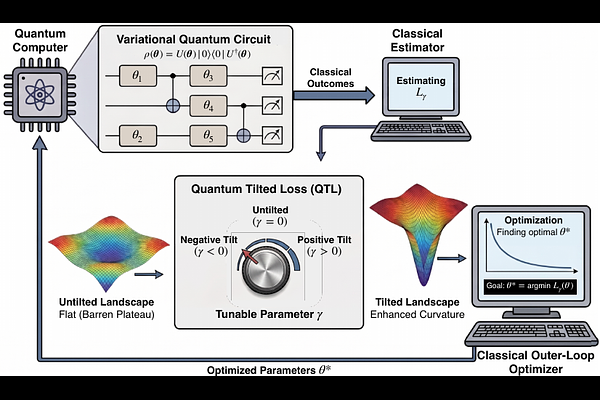
AbstractVariational quantum algorithms (VQAs) are leading strategies for using near-term quantum devices, with a well-studied bottleneck being their trainability. Standard expectation-value objectives with expressive circuits frequently encounter barren plateaus in the optimization landscape during training. To address this challenge, we introduce the Quantum Tilted Loss (QTL), an operator-level generalization of classical exponential tilting designed to systematically reshape the optimization landscape. By tuning a single continuous parameter, QTL can amplify gradient signals in structured settings while preserving the problem's true global minima. We provide a theoretical foundation that unifies standard expectation minimization with popular tunable heuristics, such as Conditional Value-at-Risk (CVaR) and Gibbs formulations. Deploying this framework requires balancing the geometric benefits of a sharpened landscape against the statistical cost of estimating nonlinear gradients from finite quantum measurements. We formalize this trainability-estimability trade-off, demonstrating how aggressive tilting fundamentally shifts the optimization bottleneck from landscape flatness to sample complexity. Thus, the operational bottleneck shifts from vanishing gradients to measurement sampling variance. Finally, we exhibit through numerical simulations that ascending tilt schedules can outperform fixed-tilt training in finite-shot regimes.