Ultrasensitive Detection of Alpha-Synuclein Oligomers in Human Plasma Using Optimized Nano-QuIC

Ultrasensitive Detection of Alpha-Synuclein Oligomers in Human Plasma Using Optimized Nano-QuIC
Jeong, H.; Christenson, P. R.; Ahn, H.; Lashuel, H. A.; Larsen, P. A.; Oh, S.-H.; Park, H. Y.
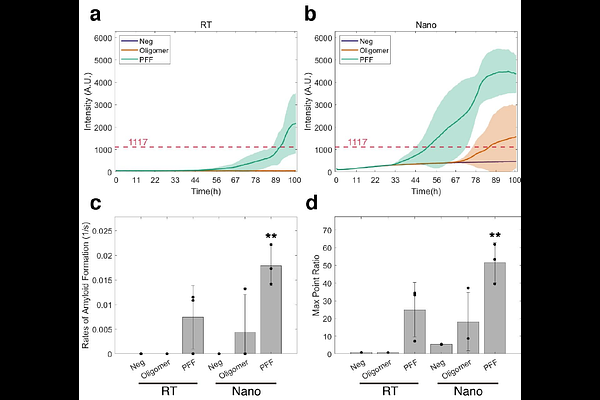
AbstractEarly diagnosis of Parkinson's disease (PD) is critical, as clinical symptoms typically emerge only after substantial neuronal loss. While -synuclein (-Syn) oligomers in blood are promising biomarkers for early detection, their clinical utility is limited by their low abundance and the presence of inhibitory components in the plasma matrix. To address these limitations, we tailored the Nanoparticle-enhanced Quaking-Induced Conversion (Nano-QuIC) platform specifically for the ultrasensitive detection of -Syn oligomers in human plasma. We identified critical reaction determinants by investigating buffer pH, ionic strength, detergent types, and shaking conditions. Furthermore, the integration of silica nanoparticles (siNPs) proved essential in mitigating plasma matrix interference, ensuring robust and reproducible protein aggregation. Under these optimized conditions, the assay achieved a detection limit of 100 pg/mL for -Syn oligomers spiked into human plasma. These results demonstrate that our adapted Nano-QuIC platform provides a highly sensitive and minimally invasive method for detecting pathological -Syn species, offering a significant advancement toward the development of early-stage PD diagnostics.