Partition Coefficients Reveal Changes in Properties of Low-Contrast Biomolecular Condensates

Partition Coefficients Reveal Changes in Properties of Low-Contrast Biomolecular Condensates
Varma, K.; Matthias, D.; Shapiro, C. B.; Bailey-Darland, S.; Matsuzawa, T.; Lorenz, C.; Bate, T.; Thornton, S. J.; Duraivel, S.; Style, R. W.; Sethna, J. P.; Dufresne, E. R.
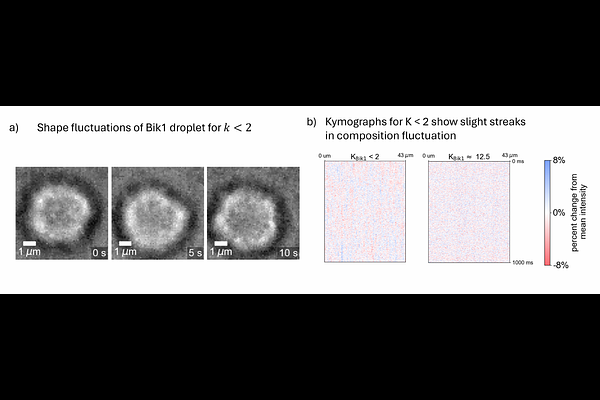
AbstractBiomolecular condensates are domains within cells with distinct compositions, held together by intermolecular cohesion. They are implicated in a variety of cellular processes, and in vitro studies have revealed the molecular driving forces that underly their condensation. However, in vitro condensates do not capture essential features of cellular condensates. In particular, enrichment of proteins, quantified by partition coefficients, is often exaggerated in these simplified systems. We show that the addition of free amino acids and other small molecules to model condensates can bring their partition coefficients within physiological range. In this limit, where there is low biochemical contrast between condensates and their surroundings, we observe striking changes to condensate behavior. Such low-contrast condensates exhibit large fluctuations in shape and composition and show enhanced sensitivity to changes in their environment. These behaviors reflect dramatic shifts to their material properties, including interfacial tension, rheology, and chemical susceptibilities. We note remarkable similarities in these effects across seemingly unrelated two-phase fluid systems. To explain these trends, we reformulate classic models of critical phenomena in terms of partition coefficients. This framework simplifies application of theory to experiments with near-critical fluids and suggests new experimental approaches for assessing condensate physiology in live cells.