A lipid acyl code-based Dip2-Pkc1 signalling axis maintains mitochondrial integrity in eukaryotes

A lipid acyl code-based Dip2-Pkc1 signalling axis maintains mitochondrial integrity in eukaryotes
Sankaranarayanan, R.; Kumar, S.; Shambhavi, S.; Zehra, A.; Chakraborty, A.; Saleem, S. M. H.; Mohapatra, A.; Pal, B.; Kalivendi, S. V.; Kamat, S. S.
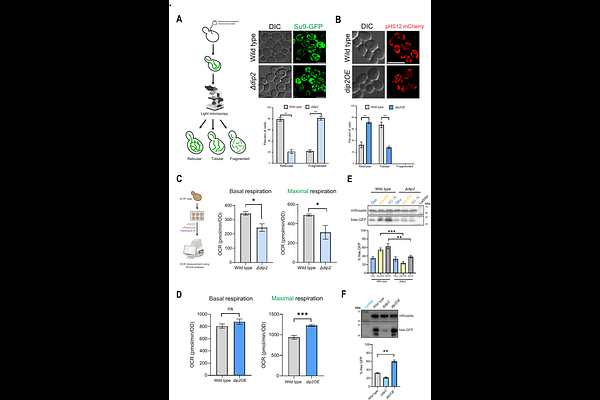
AbstractOrganelle membranes employ diverse lipids to relay key signals for efficient coordination of cellular processes. Diacylglycerol (DAG) is a simple yet critical lipid secondary messenger, but the regulatory mechanisms and functional implications for its distribution remain poorly understood. We have recently shown that Protein Kinase C (Pkc1) activation is driven by selective DAGs (C36:0, C36:1), whose levels are governed by Disco-interacting protein 2 (Dip2) (Shambhavi et al., 2025). Here, through genetic, chemical, and lipidomic screens, we show that the absence of Dip2 leads to specific DAG accumulation on the mitochondrial membrane and impacts its morphology, function, and quality control in yeast. Remarkably, the elevated DAGs in{Delta} dip2 promote translocation of Pkc1 to mitochondria via its DAG-binding C1 domain, but not the HR1 domain, suggesting functional partitioning between the regulatory domains. We also show that only specific DAGs, not the bulk DAGs, are required for Pkc1s targeting and inactivating Phospholipase C (Plc1) restores Pkc1 localisation and the associated mitochondrial defects. In addition, we identify that respiratory growth triggers specific DAG (C36:1) accumulation in the mitochondria, thereby promoting Pkc1 recruitment. Furthermore, we establish that the Psi1-Plc1-Dip2 axis is required for survival under respiratory growth conditions. Taken together, our study uncovers a novel, Dip2-mediated, unconventional Pkc1 signalling axis for maintaining mitochondrial homeostasis under nutrient transition and highlights how distinct lipid fingerprints enable precise control over organellar homeostasis.