Phenotype diversity and extinction dynamics of the European Narrow-Headed Vole, Stenocranius anglicus (Hinton, 1910) (Arvicolinae, Cricetidae, Rodentia), in Central Europe.

Phenotype diversity and extinction dynamics of the European Narrow-Headed Vole, Stenocranius anglicus (Hinton, 1910) (Arvicolinae, Cricetidae, Rodentia), in Central Europe.
Dubjelova, N.; Hadravova, T.; Ivanov, M.; Horacek, I.
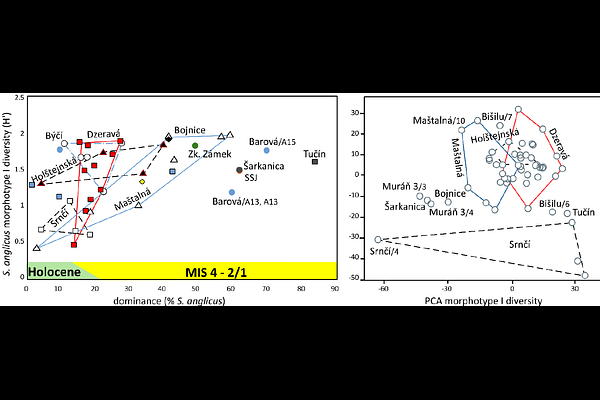
AbstractThe European Pleistocene populations of the narrow-headed vole (Stenocranius gregalis), an index species of the Palearctic glacial communities, were recently found to differ from the extant Asian species by a deep genetic divergence and are to be considered a separate species, Stenocranius anglicus, which had to persist through the interglacial stages in local European refugia. Here, we analyze over 2000 first lower molars from 14 stratified localities in the Czech Republic and Slovakia, spanning the Middle Pleistocene to Holocene, employing geometric morphometrics, biometric measurements, and morphotype classifications to assess molar shape variation. Our results demonstrate persistent morphological variability, with particularly high morphotype diversity during MIS 5-3, followed by simplification and reduced variance in post-LGM populations. Morphological divergence was greater among geographic localities than stratigraphic stages, suggesting strong regional and ecological influences. Stratified sequences reveal diverse evolutionary trajectories from long-term morphological stability in refugia to gradual simplification preceding extinction in the early Holocene. These patterns align with broader Eurasian trends but also highlight regionally specific responses to climatic and ecological change accompanying the species' extinction dynamics during the early to middle Holocene. The paper underscores the importance of integrating detailed morphometrics with stratigraphic and ecological evidence to shed light on these topics.