Genetic ablation of visual perception reveals behaviour changes in male and female malaria mosquitoes

Genetic ablation of visual perception reveals behaviour changes in male and female malaria mosquitoes
Klug, D.
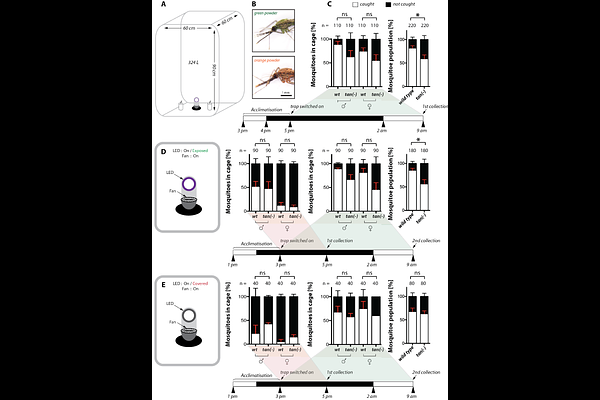
AbstractThe role of vision in the behavior of blood-feeding mosquitoes has remained largely overlooked, particularly in species of the Anopheles genus, despite their significant impact on global health. While the importance of olfactory and thermal cues in host-seeking is well established, the contribution of visual stimuli to mating and feeding behavior remains far less understood. In particular, Anopheles mosquitoes exhibit complex swarming behavior that depends on visual input, suggesting an underexplored avenue of research with direct implications for vector control. This study introduces a genetically modified mosquito line lacking the enzyme Tan, a hydrolase involved in both dopamine and histamine metabolism, to investigate the behavioral relevance of visual cues in Anopheles. Through a combination of behavioral assays and controlled laboratory experiments, the impact of visual disruption on attraction to UV-B light, host-seeking, and blood-feeding success was assessed. The findings demonstrate a reduced light-dependent attraction in both Anopheles males and females, suggesting an impairment in visual processing or a related behavioral response. This observation has implications for reproductive success and potential adaptation to anthropogenic environments with artificial light. By leveraging this novel knockout model, the study offers new tools and perspectives to better understand how vision shapes mosquito behavior and how this knowledge could be harnessed in the development of next-generation vector control strategies.