Virulence and antimicrobial resistance features among clades of Escherichia coli ST131 strains causing community-acquired urinary tract infection in Rio de Janeiro, Brazil

Virulence and antimicrobial resistance features among clades of Escherichia coli ST131 strains causing community-acquired urinary tract infection in Rio de Janeiro, Brazil
Barcellos, I. S.; Sousa, T. C. C.; de Castro, E. M.; Pereira, J. J. S. d. S.; Ferreira, A. L. P.; Rodrigues, K. M. d. P.; Moreira, B. M.; Miranda, K. R.
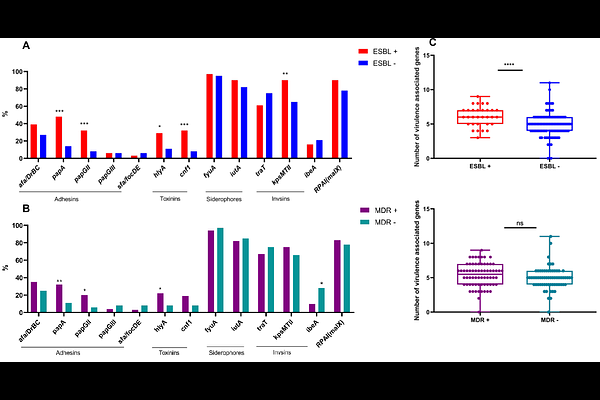
AbstractUrinary tract infection (UTI) is one of the most common community-acquired bacterial infections mainly caused by extraintestinal pathogenic Escherichia coli (ExPEC) strains. The high-risk Escherichia coli ST131 clone is a major global cause of this disease. The lineage rapid dissemination is associated to multidrug resistance (MDR), production of extended-spectrum beta-lactamase (ESBL), and multiple virulence-associated genes. Although we lack information about ExPEC high-risk clones in Latin America, we recently reported an increase in ST131 dissemination in Rio de Janeiro from 2015 to 2019. The present study aims to characterize virulence and resistance molecular and phenotypic features that may contribute to dissemination of E. coli ST131 in Rio de Janeiro, Brazil. We assessed a 133 E. coli ST131 strains collection obtained from urine of outpatients with suspected UTI, in 2019. We determined antimicrobial susceptibility, fluoroquinolones resistance genes, virulence factors associated genes and biofilm production of all strains and analyzed the frequencies by each clade or subclade. A higher incidence of women (92%) and elderly (65%) subjects was observed. Overall resistance to first- and second-line treatment for UTI antimicrobials ampicillin, ciprofloxacin and sulfamethoxazole-trimethoprim was detected in high rates (40%), with a major impact of subclade C2 strains that were resistant to almost all antimicrobials tested, 52% carry ESBL and 66% of strains harbor the aac(6')-Ib-cr ciprpofloxacin resistance gene. Clade B and subclade C2 showed higher virulence scores among the other clades. They present unique virulence profiles characterized by the presence of papGIII, sfa/focDE, and especially ibeA genes in clade B, and the afa/DrBC, papGII, hlyA, cnf1 genes in subclade C2. Over 50% of our strains are biofilm producers, characterized by weak (24%) and strong producers (32%). ESBL and MDR strains harbor mainly papA, papGII, hlyA, cnf1 and kpsMTII genes that plays a key role in ST131 colonization. Subclade C1 is the major biofilm producer (78%), despite its lower virulence score. We also detected higher incidence of papA (27%), hlyA (19%) genes and the RPAI(malX) marker (84%) in biofilm producer strains with a statistical association of sfa/focDE gene (9%). We can infer that Clade C strains might be responsible for ST131 dissemination and persistence in Rio de Janeiro.