Title: Optogenetic WNT signaling drives germ layer self-organization in a human gastruloid model

Title: Optogenetic WNT signaling drives germ layer self-organization in a human gastruloid model
Schaffer, D. V.; Johnson, H. J.; McMullin, D. M.; Zimmermann, J.; Kim, C.; Repina, N.; Bhalerao, R.; Nowakowski, T.
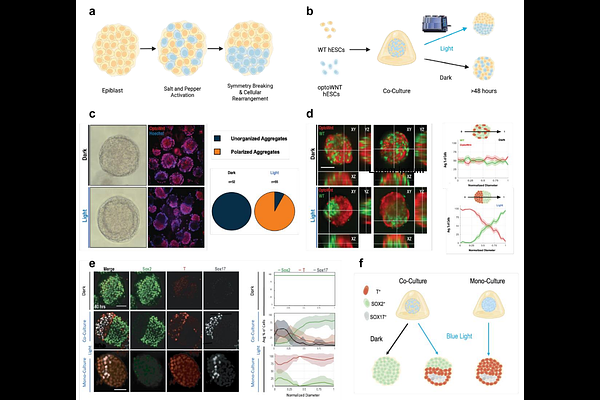
AbstractIn vitro stem cell models of human gastrulation have been an advance for developmental biology, though elucidating mechanisms of germ layer formation remains challenging. While investigating whether spatially-patterned signaling is required for germ layer formation, we tested a salt-and-pepper signaling strategy in which WNT was optogenetically activated in a subset of human pluripotent stem cells (hPSC) uniformly mixed into an aggregate. Following mesendodermal specification, WNT-activated cells spatially segregated into a hemisphere, then underwent further differentiation and organization into mesoderm and endoderm. RNAseq-based lineage analysis revealed that WNT activation non-autonomously induced TGFb/BMP signaling, leading to robust emergence of an anterior visceral endoderm-like population that patterned adjacent neural and mesendodermal fates. Transcriptional profiles and trajectories closely mirrored those observed during human gastrulation. Moreover, TGFb; or cadherin perturbation disrupted germ layer formation or spatial organization, respectively. This simple model thus enables mechanistic dissection of complex human lineage specifications and organization during gastrulation.