The last one in the row but decisive: PPDK as a potential key regulator of diurnal deacidification in CAM leaves across varying PPFD and photoperiod conditions

The last one in the row but decisive: PPDK as a potential key regulator of diurnal deacidification in CAM leaves across varying PPFD and photoperiod conditions
Daems, S.; Van de Poel, B.; Ceusters, J.
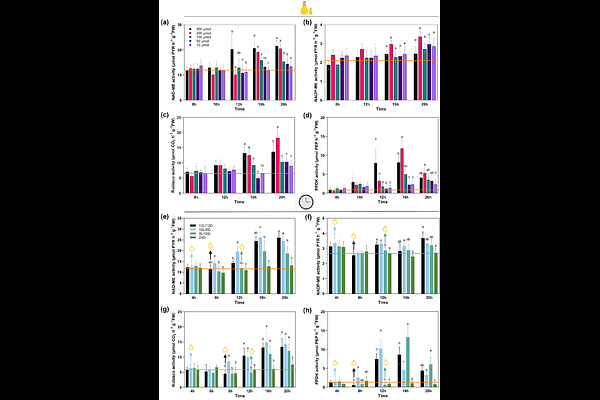
Abstract{middle dot}Crassulacean acid metabolism (CAM) plants primarily fix atmospheric CO2 at night and store it as malic acid in their vacuoles. During the light period, vacuolar malate is remobilised and decarboxylated to supply CO2 for Rubisco assimilation. Light intensity and photoperiod are believed to play crucial roles in regulating this process, but their influences on the underlying molecular and biochemical mechanisms remain unclear. {middle dot}In this study, we integrated physiological, biochemical, and molecular approaches to uncover the temporal patterns and light responsiveness of gene transcript and protein abundances, and the activities of enzymes involved in diurnal malate remobilisation in the obligate CAM model species Kalanchoe fedtschenkoi. {middle dot}Vacuolar malate transport was primarily influenced by the endogenous clock and photoperiod, with KfALMT4 being a more plausible transporter candidate than KftDT. Decarboxylation of the released malate was mainly dictated by photoperiod, with light intensity playing a supplementary role. Both photoperiod and light intensity greatly affected the final processes of CAM photosynthesis i.e. CO2 refixation and pyruvate recycling, with PPDK--the last in line--being the most strictly light-regulated player at the mRNA, protein abundance and activity levels, closely matching malate dynamics. {middle dot}Collectively, this study revealed the recycling enzyme PPDK as a potential key regulator of light-dependent diurnal deacidification in CAM leaves, rather than the vacuolar malate transport or decarboxylation processes.