Two-locus CRISPR toxin-antidote gene drive for confined population modification

Two-locus CRISPR toxin-antidote gene drive for confined population modification
Feng, R.; Tan, Y.; Lu, Z.; Chen, Y.; Champer, J.
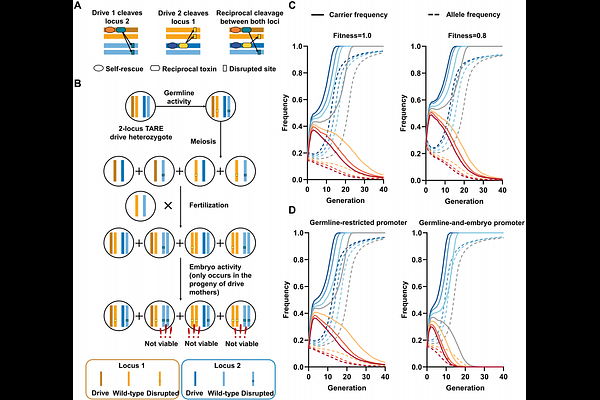
AbstractGene drive systems enable rapid spread of desired transgenes throughout populations. Advances in CRISPR technology have facilitated the construction of toxin-antidote gene drives, which utilize a CRISPR nuclease as the toxin to disrupt an essential wild-type gene alongside a recoded version of the same gene as the antidote. Because these systems propagate by eliminating wild-type alleles rather than directly copying themselves like homing drives, they typically exhibit introduction thresholds, allowing them to be confined to target populations. Previous work developed the efficient Toxin-Antidote Recessive Embryo (TARE) drive, but its threshold may be too low in challenging confinement scenarios. Here, we constructed a 2-locus TARE drive system. It has underdominance characteristics, yielding a higher introduction threshold, even when drive performance is ideal. It targets the essential but haplosufficient genes hairy and sim using two different drives at different genomic locations, each targeting the gene that the other rescues. Our system involved two linked elements together with rare homology-directed repair-mediated drive conversion, reducing the threshold to compensate for fitness costs. The system showed high efficiency in individual crosses. When released into multigenerational cage populations above the introduction threshold, the drive successfully and rapidly modified the entire population, and when below this threshold, it was eliminated. Our findings indicate that 2-locus TARE drives represent promising tools for effective and strongly confined population modification.