Endogenous autophagosome reporters reveal redundant and non-redundant roles of LGG-1 and LGG-2 in C. elegans neuronal autophagy

Endogenous autophagosome reporters reveal redundant and non-redundant roles of LGG-1 and LGG-2 in C. elegans neuronal autophagy
Tsong, H.; Rodriguez, M. N.; Stavoe, A. K.
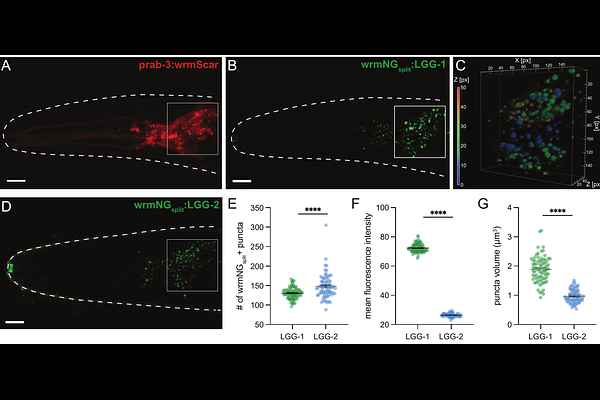
AbstractAutophagy is a conserved cellular recycling pathway essential for neuronal development and homeostasis. Neurons are highly polarized cells that rely on the continual turnover of cytoplasmic content through processes like autophagy to maintain cellular function. Here, we employed novel endogenous autophagosome reporters to define the distinct expression patterns, spatial distribution, and compensatory potential of the two C. elegans Atg8 orthologs, LGG-1 and LGG-2, in the nervous system. We labelled LGG-1 and LGG-2 with split wrmNeonGreen to endogenously label autophagosomes in individual neurons. We observed brighter and larger wrmNGsplit:LGG-1 autophagosomes relative to smaller and dimmer wrmNGsplit:LGG-2 autophagosomes pan-neuronally and in the individual AIY and NSM neurons. When we interrogated autophagosome trafficking in the AIY neurite, we revealed a similar trafficking mechanism for both LGG-1 and LGG-2 puncta. In AIY and pan-neuronally, we found that lgg-2 was required for LGG-1 puncta formation. Strikingly, in lgg-1 mutants, LGG-2 demonstrated a compensatory capacity in the AIY neuron via an upregulation of LGG-2 autophagosomes. Overall, our findings demonstrate the advantages of this novel endogenous reporter system for tracking neuronal autophagy and further elucidate redundant and non-redundant functions of LGG-1 and LGG-2.