Spatial information transfer in recurrent place-cell networks depends on excitation-inhibition balance, neural-circuit heterogeneities, and trial-to-trial variability

Spatial information transfer in recurrent place-cell networks depends on excitation-inhibition balance, neural-circuit heterogeneities, and trial-to-trial variability
Roy, R.; Narayanan, R.
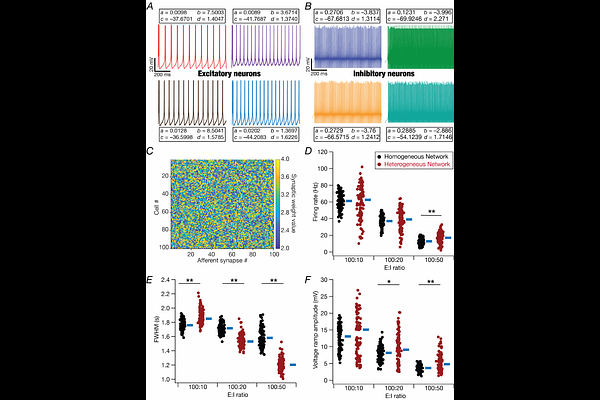
AbstractA key challenge in understanding spatial navigation and memory is explaining how hippocampal networks sustain robust spatial information transfer despite pronounced trial-to-trial variability and pervasive neural-circuit heterogeneities. Although hippocampal heterogeneities and physiological variability are well-characterized, circuit-scale understanding of stable information transfer in recurrent place-cell networks remains limited. Here, we first show that even recurrent networks composed of intrinsically identical neurons and receiving identical place-field inputs express pronounced neuron-to-neuron variability in spatial tuning profiles, place-field widths, subthreshold ramp amplitudes, and spatial information transfer. Introduction of intrinsic within-type heterogeneities to excitatory and inhibitory neurons further increased diversity in firing properties, but strikingly improved robustness of spatial information transfer under high trial-to-trial variability. Although strengthening inhibition expectedly narrowed place fields and reduced firing across all networks, the impact of inhibition on information-transfer profiles was stronger in heterogeneous networks manifesting high degree of trial-to-trial variability. Across networks, increasing trial to trial variability reduced information transfer and shifted the spatial location of peak information from the high slope regions of the tuning curve to its peak firing location. Finally, incorporating afferent heterogeneities allowed neurons to be tuned to distinct place field centers, reducing peak information values while amplifying neuron to neuron diversity in information transfer profiles. Together, we demonstrate that excitation-inhibition balance, trial-to-trial variability, within-type heterogeneities, and afferent input diversity jointly regulate spatial information transfer in recurrent place-cell circuits. We also highlight intrinsic heterogeneities as substrates for enhanced robustness of spatial coding against perturbations. Importantly, the convergence of multiple disparate mechanisms in yielding similar information transfer profiles underscores degeneracy as a fundamental organizing principle in neural-circuit physiology.