A novel class of ultra-stable endospore appendages decorated with collagen-like tip fibrillae

A novel class of ultra-stable endospore appendages decorated with collagen-like tip fibrillae
Remaut, H.; Sleutel, M.; Zegeye, E. D.; Llarena, A.-K.; Pradhan, B.; Fislage, M.; O'Sullivan, K.; Aspholm, M. E.
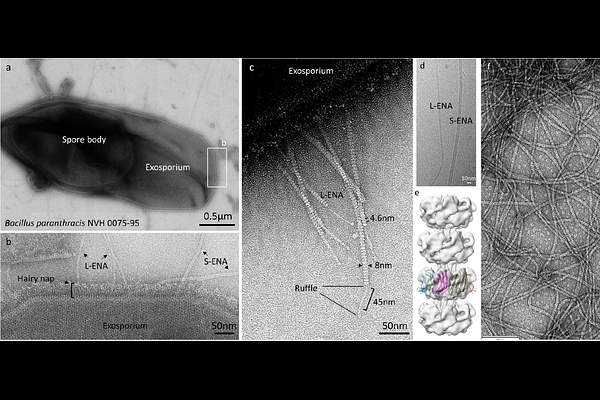
AbstractBacterial endospores are remarkable examples of biological resilience, representing a dormant and heavily fortified differentiation form capable of withstanding physical and chemical stressors detrimental to vegetative cells. In pathogenic firmicutes, spores also form an infectious particle and can take up a central role in the environmental persistence and dissemination of disease. A poorly understood aspect of spore-mediated infection is the fibrous structures or \'endospore appendages\' (ENAs) that have been seen to decorate the spores of pathogenic Bacilli and Clostridia. New methodological approaches are opening an unprecedented window on these long enigmatic structures. Using cryoID, Alphafold modelling and genetic approaches we identify a novel class of ultra-robust ENAs formed by Bacillus paranthracis. We demonstrate that L-ENA are encoded by a three-gene cluster (ena3) that contains all components for the self-assembly of ladder-like protein nanofibers of stacked heptameric rings, their anchoring to the exosporium, and their termination in a trimeric \'ruffle\' made of a collagen-like BclA paralogue. Phylogenomic analyses shows the ena3 gene cluster as a mobile element with a polyphyletic distribution across pathogenic Bacilli.