One Chromatin, Many Structures: From Ensemble Contact Maps to Single-Cell 3D Organization

One Chromatin, Many Structures: From Ensemble Contact Maps to Single-Cell 3D Organization
Carignano, M. A.; Kroeger, M.; Almassalha, L.; Backman, V.; Szleifer, I.
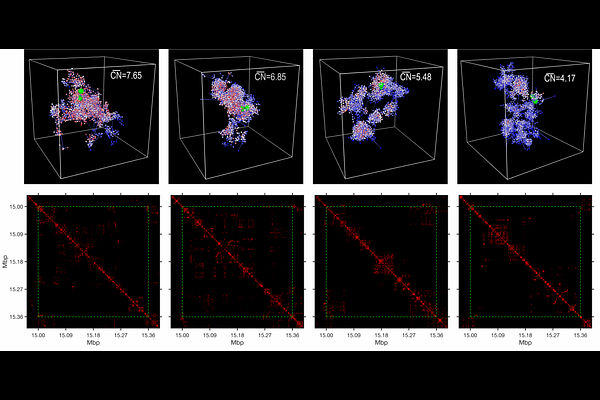
AbstractUnderstanding how chromatin folds in three dimensions remains challenging because most experimental assays capture low-dimensional projections of an underlying, highly heterogeneous polymer. Here we present an ensemble-based interpretive framework built on the previously introduced Self-Returning Excluded Volume (SR-EV) model, a minimal generator of nucleosome-resolution chromatin conformations based on stochastic return rules and excluded-volume geometry. Despite its simplicity, SR-EV reproduces key experimental signatures across scales: heterogeneous nanoscale packing domains resembling ChromEMT and ChromSTEM observations, sparse and highly variable single-configuration contact patterns analogous to single-cell chromosome conformation capture (Hi-C), and robust ensemble-level contact enrichment consistent with topologically associating domains (TADs). In this framework, Hi-C loop and TAD signatures are interpreted as ensemble-level statistical enrichments rather than invariant features of single-cell conformations. SR-EV is explicitly designed to generate large ensembles of complete three-dimensional chromatin configurations that can be projected consistently onto two-dimensional contact maps and one-dimensional genomic profiles. By introducing architectural-protein effects only through ensemble selection rather than explicit forces, SR-EV supports a separation between intrinsic polymer geometry and regulatory bias and suggests that TAD-like features can emerge as statistical enrichments rather than deterministic three-dimensional structures. Coordination number and probe-based accessibility computed directly from SR-EV provide a unified link between three-dimensional packing, two-dimensional contact maps, and one-dimensional genomic profiles. Together, these results establish SR-EV as a minimal and physically grounded reference framework for interpreting how heterogeneous chromatin ensembles give rise to multimodal experimental observables, while remaining consistent with the fact that chromatin organization is realized in individual cells.