The First 1,000 Days (1kD) Project - Collecting and Analyzing an Ultra-Dense Naturalistic Dataset of Human Baby Development

The First 1,000 Days (1kD) Project - Collecting and Analyzing an Ultra-Dense Naturalistic Dataset of Human Baby Development
Raviv, H.; Hasenfratz, L.; Gousios, K.; Faryna, M.; Beaty, R.; Johnson, D.; Chen, B.; Altenhof, A.; Ryan, B.; Greenberg, C. A.; Hong, Z.; Assayag, G.; Tsyhanov, A.; Malakhov, V.; Rosenwein, T.; Raviv, O.; Lew-Williams, C.; Hasson, U.
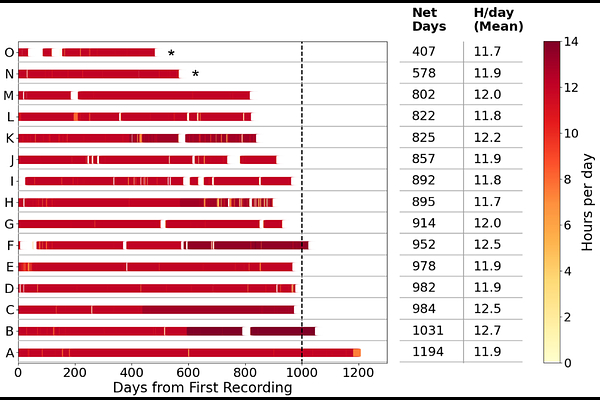
AbstractHuman development unfolds in continuous, multimodal environments across seconds, days, and years, yet most developmental datasets capture sparse, context-limited samples of everyday life. We introduce the First 1,000 Days (1kD) Project, an initiative designed to collect ultra-dense, longitudinal, child-centered data that capture developmental trajectories within their full ecological context. Fifteen U.S. homes with 17 infants were recorded 12-14 hours per day over a median of 944 days, yielding ~1.18 million hours of raw audiovisual data. We present an end-to-end framework for large-scale longitudinal naturalistic measurement and a scalable analysis pipeline of the collected data. In a case study, we describe how we utilized our pipeline to isolate child-centered speech, resulting in the collection of 2,000 to 6,000 hours of transcribed speech for each infant. We demonstrate that dense sampling within the home environment reveals a stable, household-specific lexical structure, which sparse sampling methods consistently fail to capture. The 1kD project offers a blueprint for teams aiming to collect and analyze natural behavior at scale in real-world settings.