Early Colonic and Microbial Responses Precede Hyperphagia in Short Bowel Syndrome: Insights from a Rat Model

Early Colonic and Microbial Responses Precede Hyperphagia in Short Bowel Syndrome: Insights from a Rat Model
Garrigues, A.; Bourgin, M.; Dumay, A.; Shahrour, H. E.-J.; Roy, M.; Willemetz, A.; Ribeiro-Parenti, L.; Kapel, N.; Bado, A.; Le Gall, M.; Le Beyec, J.
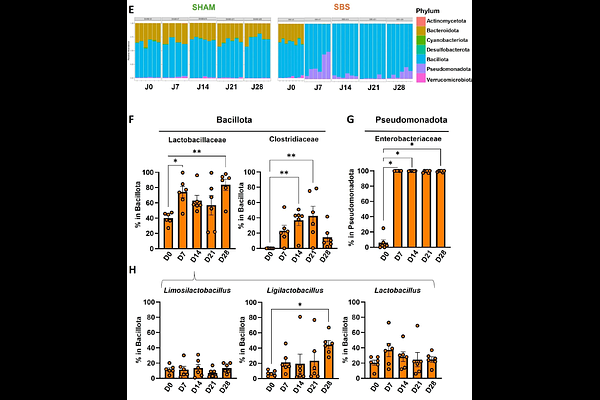
AbstractBackground: Short bowel syndrome (SBS) resulting from extensive small bowel resection is characterized by severe malabsorption and represents the leading cause of intestinal failure. Although spontaneous intestinal adaptation can partially restore nutrient absorption, the temporal coordination and hierarchy of the adaptive mechanisms involved, particularly those linking the gut microbiota, enteroendocrine function, hyperphagia, and intestinal remodeling, remain incompletely understood. Methods: We investigated the kinetics of spontaneous intestinal adaptation in a rat model mimicking type 2 SBS over a 28-day postoperative period. Body weight, food intake, gastrointestinal transit, fecal losses, intestinal morphology, enteroendocrine hormone secretion, hypothalamic neuropeptide expression, and gut microbiota composition were assessed longitudinally in SBS and SHAM-operated rats. Results: Extensive small bowel resection induced marked early weight loss, accelerated intestinal transit, diarrhea, and increased fecal energy losses that persisted throughout the follow-up. Profound gut microbiota remodeling occurred as early as day 7, remained largely stable thereafter, and was characterized by reduced diversity and enrichment in Lactobacillaceae and Enterobacteriaceae. Early elongation of remaining colon and epithelial remodeling were observed, preceding the jejunal hyperplasia, which became evident from day 14 onward. Enteroendocrine adaptation was marked by an early increase in plasma peptide YY levels, whereas glucagon-like peptide-1 showed a modest response. Food intake was increased in SBS rats from day 7 onward, and hyperphagia developed gradually and reached a plateau by the end of the third postoperative week, in parallel with increased hypothalamic AgRP levels and reduced POMC levels. No significant improvement of intestinal transit and fecal energy losses was observed during the study period. Conclusion: Intestinal adaptation to extensive resection follows a time-dependent sequence in which early gut microbiota remodeling and colonic adaptation precede hyperphagia and small intestinal remodeling. These findings highlight the gut microbiota and the colon as central components of the early post-resection adaptation and potential therapeutic targets in SBS.