Drowning in a sandy ocean: Epiarenic growth of Tillandsia in the hyperarid Atacama Desert

Drowning in a sandy ocean: Epiarenic growth of Tillandsia in the hyperarid Atacama Desert
Schweikert, R.; Stein, R. E.; Bogs, N.; Bubenzer, O.; Del Rio, C.; Harpke, D.; May, S. M.; Siegmund, A.; Stoll, A.; Quandt, D.; Koch, M. A.
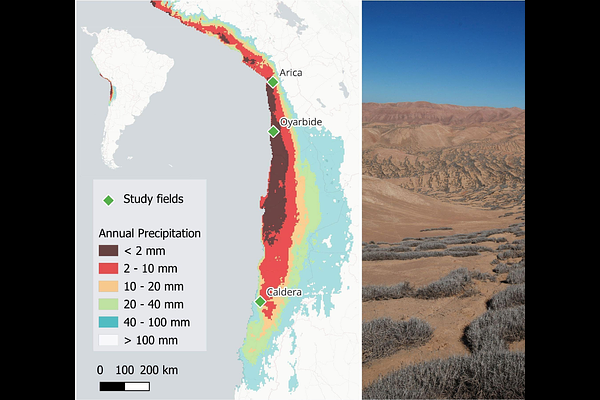
AbstractThe Atacama Desert hosts a unique ecosystem formed by the sand-dwelling Tillandsia landbeckii, which extends over hundreds of square kilometers. This vegetation relies primarily on fog as its main water source; however, aeolian sand also plays a crucial role in the long-term persistence of both the species and the overall plant community. The terrain is sloped and exposed to the prevailing wind direction. Tillandsia forms regular banding patterns oriented orthogonally to these landscape features. In this study, we aim to elucidate the abiotic-biotic interactions between sand properties and vegetation characteristics through a comparative approach. Three populations, Caldera, Oyarbide and Arica, each spanning several square kilometers in the southern, central, and northern regions of the Chilean Atacama Desert, were selected to compare wind regimes, terrain structure, sand and substrate properties, and vegetation structure in order to identify common principles that maintain vegetation integrity. Data were collected from six climate stations, 1,246 substrate samples, population genomic data from 718 individuals, as well as satellite imagery and digital terrain models. Our findings demonstrate that regional wind systems transport sand from distant source areas, while near the ground, Tillandsia vegetation reduces wind velocity and traps sand, leading to the formation of moderately sorted sandy substrates that are similar across all three populations. Sites lacking or containing dead Tillandsia individuals often differ significantly in substrate characteristics. Genetic analyses indicate that Tillandsia populations exhibit strong spatial structure albeit recruiting high genetic diversity and an excess of heterozygosity, reflecting adaptation to the dynamic environmental conditions. We conclude that sand represents an essential component of this ecosystem, while Tillandsia, as the dominant biotic factor, actively shapes and maintains this distinctive desert environment.