Unstructured regions differentially modulate the activation of RBOHD and RBOHH

Unstructured regions differentially modulate the activation of RBOHD and RBOHH
Citterico, M.; Neubergerova, M.; Porcher, A.; Zeiner, A.; Pejchar, P.; Korec Podmanicka, T.; Potocky, M.; Kangasjärvi, S.; Pleskot, R.; Wrzaczek, M.
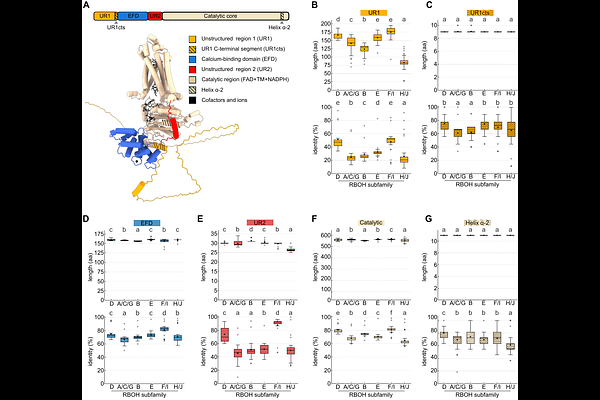
AbstractReactive oxygen species (ROS) produced by plant NADPH oxidases (RBOHs) must be precisely controlled in their concentration and spatial distribution to support diverse developmental and stress responses. RBOHs are activated by Ca2+ binding and phosphorylation, yet how internal regulatory domains within RBOHs have evolved to translate these inputs into precise levels of ROS production remains unclear. To address this, we performed phylogenetic analyses to define RBOH subfamilies and identify protein regions underlying functional diversification. This analysis revealed that the most variable regions across land-plant RBOHs are two unstructured regions in the N-terminus, UR1 and UR2, which flank the EF-hand Ca2+-binding domain (EFD). We dissected the roles of these regions in Arabidopsis RBOHD, which is central to plant immunity, and in RBOHH, which drives pollen tube elongation and exhibits high Ca2+-induced ROS production. Our analyses revealed that UR1 plays opposing roles in these RBOHs: in RBOHD, UR1 functions as an autoinhibitory module that restrains Ca2+-mediated activation, whereas in RBOHH, UR1 is essential for Ca2+-dependent activation and has coevolved with the EFD to maximize Ca2+-induced ROS production. We further uncovered divergent regulatory roles for UR2. In RBOHD, but not in RBOHH, phosphorylation of UR2 stabilizes an -helical conformation that promotes interaction with the catalytic domain required for enzymatic activation. Furthermore, unlike in RBOHH, the EFD of RBOHD has coevolved with UR2 to maximize phosphorylation-induced activity. Together, our results show how evolution of unstructured regulatory regions adapts a conserved enzymatic core to distinct demands of immune signaling and polarized growth.