Quantitative Mapping of Sulfation, Iduronic Acid, and Secondary Structure in Glycosaminoglycans

Quantitative Mapping of Sulfation, Iduronic Acid, and Secondary Structure in Glycosaminoglycans
Riopedre-Fernandez, M.; Biriukov, D.; Martinez-Seara, H.
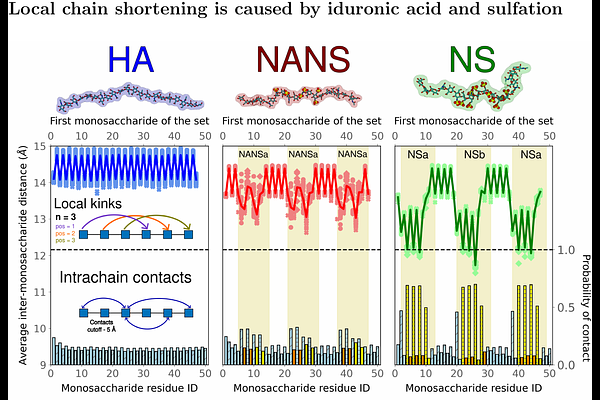
AbstractGlycosaminoglycans (GAGs) are extracellular matrix polysaccharides whose sequence variability and chemical modifications, particularly sulfation, generate substantial structural diversity. However, how sulfation patterns and monosaccharide composition encode secondary structure in GAGs is not systematically resolved, and quantitative metrics for classifying these structures are largely lacking. Here, we employ large-scale all-atom molecular dynamics simulations to investigate the molecular origin of secondary structure in sulfated GAGs. We systematically vary sulfation patterns and monosaccharide composition to isolate the factors that promote changes in three-dimensional structure. We show that GAG helical conformations arise from recurrent local shortening motifs caused primarily by stabilization of L-iduronic acid in the 1C4 puckering conformation, promoted by 2-O-sulfation or by densely sulfated regions. We also introduce a two-parameter structural metric that objectively classifies GAG secondary structures and distinguishes heparin helices from related conformations. Together, our results establish a quantitative link between monosaccharide identity, sulfation pattern, and three-dimensional organization of polysaccharide chains, providing a framework for future studies of sequence--structure relationships in GAGs.