Direct measurement of in vitro response to Praziquantel in Schistosoma mansoni populations from Western Kenya

Direct measurement of in vitro response to Praziquantel in Schistosoma mansoni populations from Western Kenya
Ndombi, E. M.; Oguso, J.; Olilah, P.; Orao, C.; Otieno, B.; Morales, M.; Le Clech, W. M.; Chevalier, F. D.; Anderson, T. J.
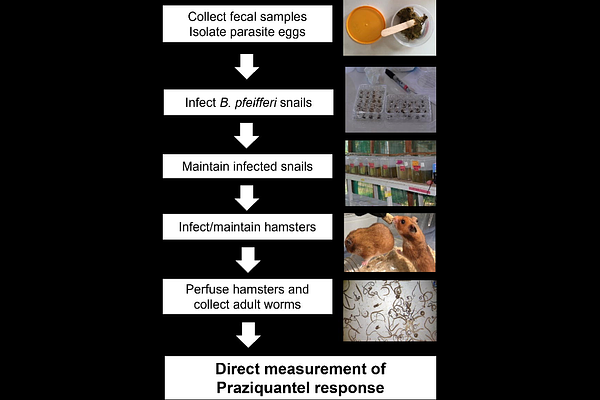
AbstractLarge-scale treatment with praziquantel (PZQ) monotherapy is used to control schistosomiasis, leading to concerns about the emergence of PZQ-resistance. In Western Kenya, schistosome-infected patients frequently remain egg-positive following PZQ treatment, and several hotspot villages have been observed where transmission remains high, despite annual mass PZQ treatments. This project asks (i) whether PZQ-resistant parasites are found in Western Kenya and (ii) whether hotspot villages can be explained by a higher prevalence of PZQ-resistant parasites. We established a simple platform for directly assaying worm motility following in vitro PZQ-exposure in adult schistosomes isolated from a field setting. To do this, we established snail and hamster breeding colonies, and generated large populations of field-derived adult worms, by (i) harvesting S. mansoni eggs from multiple infected patients; (ii) infecting Biomphalaria spp snails with miracidia; (iii) infecting hamsters with released cercariae; (iv) perfusing adult worms from hamsters, and (iv) examining drug response following exposure to PZQ (1 g/ml for 1 day) in individual S. mansoni worms using an automated movement assay. We measured PZQ-response in 1,800 adult male parasites, representing an estimated 185 parasite genotypes. We identified a single worm that remained motile after PZQ-exposure among the 185 parasite genotypes surveyed (frequency = 0.54%; 95% CI 0.01 - 2.97%, exact binomial) consistent with PZQ-resistant worms being extremely rare or absent. Our direct phenotypic screening results suggests that (i) PZQ-resistance is not currently an obstacle for S. mansoni control in Western Kenya, and (ii) that other factors explain the existence of persistent hotspots.