An Inositol Receptor Orchestrates Carbon Utilization and Fungal Virulence

An Inositol Receptor Orchestrates Carbon Utilization and Fungal Virulence
Wang, Y.; Tancer, R.; Wear, M.; Jackson, K. M.; Zhang, Y.; Gao, Y.-G.; Nielsen, k.; Casadevall, A.; Xue, C.
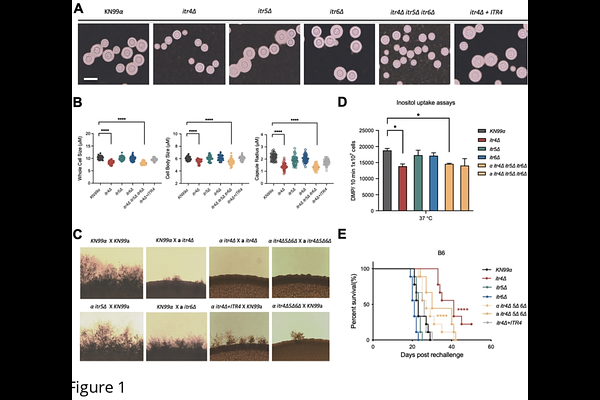
AbstractNutrient sensing and utilization are critical for microbes to adapt to their environment and evade predators. The encapsuled yeast Cryptococcus neoformans has a unique ability to sense and utilize the sugar inositol as both a signaling molecule, and as a carbon source. This trait is advantageous not only in the natural environment, but to promote its pathogenesis, including invasion of the central nervous system. Unlike many other fungal species, which utilize the canonical carbon catabolite repression (CCR) mechanism to prioritize glucose metabolism, we have identified a novel inositol transporter-like receptor (transceptor) Itr4 that also regulates CCR genes to maintain inositol metabolism activity even under high glucose conditions. Itr4 binds inositol and regulates the function of other inositol transporters (ITRs) and its loss leads to a significant decrease in inositol uptake activity, resulting in a lack of mating, reduced capsule size, reduced blood brain barrier (BBB) penetration, and virulence attenuation. Mutagenesis analysis of Itr4 protein identified an essential N-terminal tail and two amino acids, Q388 and Q389, as sites of functional importance. The ITR4Q388A, Q389A allele showed a dominant phenotype with increased inositol uptake, enlarged capsule and significantly attenuated virulence. In summary, we identify a new C. neoformans inositol transceptor, Itr4, the first such example in eukaryotes, with novel regulatory roles in both inositol and glucose metabolism and fungal virulence.