Resistance to protoporphyrinogen oxidase inhibitor herbicides in giant ragweed (Ambrosia trifida) is associated with a novel R98Q target-site mutation in PPO2

Resistance to protoporphyrinogen oxidase inhibitor herbicides in giant ragweed (Ambrosia trifida) is associated with a novel R98Q target-site mutation in PPO2
Bernardi Rankrape, C.; Werle Noe, I.; Lago, E.; Lopez, A. J.; Tranel, P. J.; Gage, K. L.
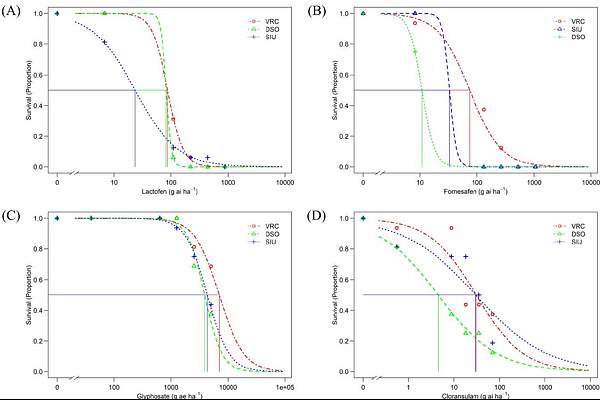
AbstractReduced control of giant ragweed (Ambrosia trifida L.) with protoporphyrinogen oxidase (PPO)-inhibiting herbicides was recently reported in two southern Illinois populations, VRC and TMS. The objectives of this study were to assess resistance to postemergence-applied PPO inhibitors in VRC and TMS, evaluate VRC response to acetolactate synthase (ALS)- and enolpyruvyl shikimate phosphate synthase (EPSPS)-inhibiting herbicides, and identify target-site mechanisms associated with PPO-inhibitor resistance. Reduced control of giant ragweed (Ambrosia trifida L.) with protoporphyrinogen oxidase (PPO)-inhibiting herbicides was recently reported in two southern Illinois populations, VRC and TMS. The objectives of this study were to assess resistance to postemergence-applied PPO inhibitors in VRC and TMS, evaluate VRC response to acetolactate synthase (ALS)- and enolpyruvyl shikimate phosphate synthase (EPSPS)-inhibiting herbicides, and identify target-site mechanisms associated with PPO-inhibitor resistance. VRC and TMS have evolved resistance to lactofen and fomesafen, and VRC also exhibited reduced sensitivity to cloransulam-methyl and glyphosate. PPO2 R98Q is novel in A. trifida and, to our knowledge, represents the first report of this mutation associated with PPO-inhibitor resistance in plants. The absence of target-site alterations in TMS suggests a potential non-target-site basis for resistance. These findings highlight the need for integrated, diversified management to further reduce herbicide selection pressure.