Geometric Structure in Sperm Whale Communication:Hyperbolic Embeddings, Topological Analysis, and AdversarialRobustness

Geometric Structure in Sperm Whale Communication:Hyperbolic Embeddings, Topological Analysis, and AdversarialRobustness
Bond, A. H.
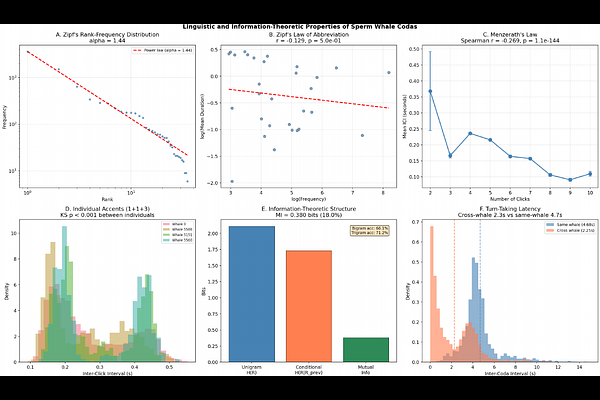
AbstractRecent work has revealed that sperm whale (Physeter macrocephalus) codas possess a combinatorial phonetic structure comparable in complexity to human phonological systems. We apply differential geometry, algebraic topology, and adversarial robustness testing to 8,719 annotated codas from the Dominica Sperm Whale Project. We show that: (1) the hierarchical coda type taxonomy admits a natural Poincare ball embedding that provides interpretable visualisation of the tree-like combinatorial structure, with classification accuracy competitive with Euclidean baselines; (2) persistent homology on inter-click interval point clouds reveals topologically distinct signatures per rhythm class; (3) adversarial acoustic perturbations applied to a nearest-centroid decoder reveal asymmetric classification boundary crossings (mean asymmetry = 0.87); (4) the coda system satisfies Menzerath's law (r = 0.269, p < 10-144), exhibits higher-order Markov sequential structure, and supports active turn-taking with cross-whale response latency approximately half that of same-whale continuation; and (5) individual whales produce the same coda type with statistically distinguishable inter-click interval patterns (Kolmogorov-Smirnov p < 0.001 for all tested pairs), confirming individual identity encoding. We introduce the Decoder Robustness Index (DRI), the first adversarial robustness benchmark for cetacean communication decoders, and demonstrate that adversarial perturbation serves as a phonetic boundary discovery tool. All methods are released as the open-source eris-ketos toolkit.