Explaining the unexplained admixture mapping signals via rare variants: the HCHS/SOL

Explaining the unexplained admixture mapping signals via rare variants: the HCHS/SOL
Chen, X.; Argos, M.; Yu, B.; Boerwinkle, E.; Qi, Q.; Kaplan, R.; Franceschini, N.; Sofer, T.
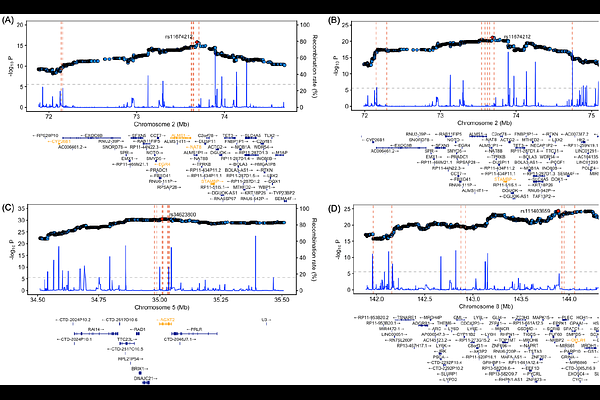
AbstractIn admixed populations, formed by a mixing of two or more previously isolated populations, genomic segments can be traced to their ancestral populations ("ancestries"). Admixture mapping (AM) associates local ancestry with outcomes in admixed populations, detecting signals when causal variants differ in frequency or effect across ancestral populations. Prior work showed that adjusting for nearby GWAS-identified common variants does not fully explain some AM signals. Here, we assessed two approaches to explain the previously unexplained AM signal: (1) including sets of rare variants; (2) increasing the genomic region considered when searching for common variants. We studied these hypotheses comprehensively using a whole-genome sequencing dataset coupled with metabolomics from the Hispanic Community Health Study/Study of Latinos. We detected multiple sets of rare variants with replicated association with metabolite levels. Yet these rare variants appear to explain only a small fraction of the AM signal, while inclusion of common variants from a larger genomic region appears to explain the majority of the AM signals.