Geodesic-informed neural networks for testing spacetimes with S2

Geodesic-informed neural networks for testing spacetimes with S2
Prajwal Hassan Puttasiddappa, Dennis Fremstad, Abdolali Banihashemi, David F. Mota
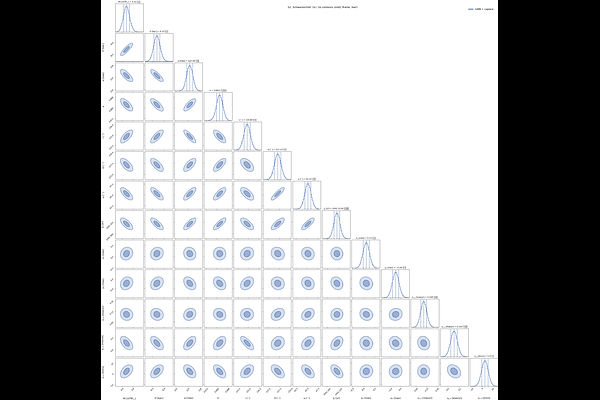
AbstractStellar orbits around Sagittarius A*, in particular that of S2, test the spacetime of the Galactic Center. Such analyses usually integrate the equations of motion for every likelihood evaluation and sample the posterior. We develop a differentiable orbit model for static, spherically symmetric spacetimes that obtains the parameters, their uncertainties and the Bayesian evidence by optimization rather than sampling. In the Geodesic-Informed Neural Network (GINN), the conserved quantities, the shape of the orbit and the redshift are computed exactly from the metric, and a neural network constrained by the geodesic equation represents the time evolution of the radial phase. The physical parameters and the network weights minimize a single loss with Adam and Gauss-Newton steps, and the curvature at the minimum gives the uncertainties and the evidence. We test this Gaussian approximation against a second-order expansion and an exact geodesic solver, and apply GINN to the S2 data in the Schwarzschild, Reissner-Nordström, hairy Horndeski, Bardeen, Janis-Newman-Winicour and Yukawa spacetimes. GINN reproduces the estimates and uncertainties of the exact solver. For Schwarzschild we find $M=(4.32\pm0.22)\times10^6\,M_\odot$ and $D=8.33\pm0.21$ kpc. No spacetime deviates significantly from Schwarzschild; a Yukawa correction, for example, is limited to $|δ|<0.011$ (95%) at a range of about 180 AU. No additional parameter improves the fit enough to pay its Occam penalty, so the Bayes factors range from inconclusive to moderate in favor of Schwarzschild. The Gaussian approximation is accurate when the hair enters the metric linearly and conservative when it enters only through its square. When the posterior is close to Gaussian, GINN gives the estimates, their uncertainties and the evidence from a single optimization, and the same derivatives quantify departures from it.