Locomotion-invariant prefrontal-thalamic goal states organize spatially aligned episode-specific hippocampal maps

Locomotion-invariant prefrontal-thalamic goal states organize spatially aligned episode-specific hippocampal maps
Golipour, Z.; Yen, S.-F.; Üstüner, C.; Ito, H. T.
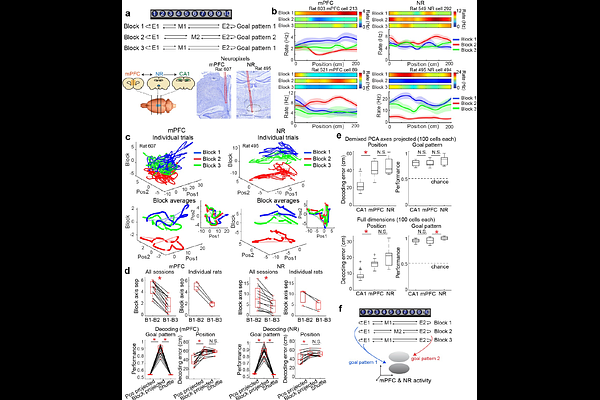
AbstractAnimals repeatedly traverse the same environment to pursue different goals, yet the hippocampus must preserve a stable spatial map while keeping individual episodes distinct. Here we show that, when animals navigate the same maze under different goal configurations, hippocampal CA1 segregates navigation episodes by encoding goal state along a population dimension orthogonal to the spatial coding subspace, rather than by reorganizing spatial representations themselves, allowing episode-specific maps to remain spatially aligned. This goal-state signal is supplied by a prefrontal-thalamic pathway, in which population activity in medial prefrontal cortex and nucleus reuniens forms persistent representations across locomotion and immobility and is reliably reinstated when previously experienced goal configurations recur. Silencing the nucleus reuniens selectively abolishes CA1 goal-state coding by disrupting goal-axis separation and goal-biased pre-navigation spike sequences while sparing spatial coding. Together, these findings identify a circuit- and population-level mechanism that enables episode-specific hippocampal representations to coexist within spatially consistent maps independent of locomotor state, linking internal goal states to navigation and planning.