Rapidly decreasing phasic dopamine responses precede a hedonic switch during satiation of sodium appetite

Rapidly decreasing phasic dopamine responses precede a hedonic switch during satiation of sodium appetite
Bazzino, P.; Russchen, D. C.; Keinath, A. T.; Roitman, M. F.; McCutcheon, J. E.
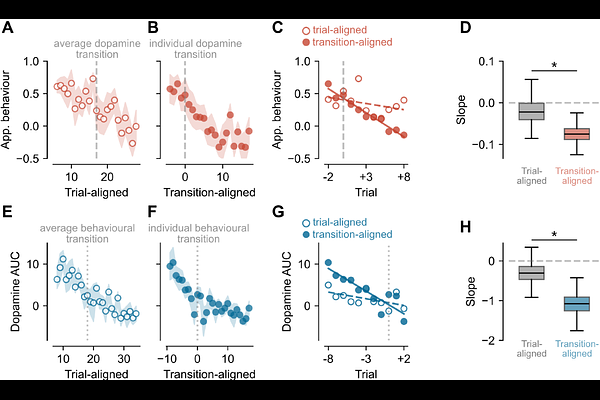
AbstractPhasic dopamine signalling updates the value of stimuli and actions. Most empirical support for this critical process involves manipulation of extrinsic stimuli (e.g., reward magnitude, reward omission). Yet interoceptive signals clearly influence motivated behaviour. Sodium depletion generates a sodium appetite where the value of sodium increases. How the value of sodium is updated during ingestion and as animals satiate their need remains unknown. Here, we administered sodium chloride solutions via intraoral delivery and measured appetitive behaviour and dopamine release in sodium replete and deplete rats. Two different concentrations of sodium chloride were used to modulate the rate of repletion for sodium deplete rats. Appetitive behaviour was evoked by infusions only when rats were deplete, and this behavioural motif faded away during the session only when high concentration infusions were delivered. Phasic dopamine release in the nucleus accumbens had a similar pattern. We identified transition points for both behaviour and dopamine in the subgroup of rats that reached satiation and found that transitions were sharp, with dopamine decreasing just before behaviour. Moreover, transitions occurred only after enough sodium was infused to replace that typically lost upon depletion. These findings demonstrate that mesolimbic dopamine dynamically updates the value of taste stimuli based on interoceptive signals that relay satiation.