Combination siRNA delivery as a therapeutic strategy for ADPKD

Combination siRNA delivery as a therapeutic strategy for ADPKD
Giblin, J.; Suzuki, I.; Huang, Y.; Lambaren, K.; LaMastro, V.; Pham, J.; Simon, R.; Zarate-Diaz, J.; Osouli, A.; Bae, S. L.; Hallows, K.; Chung, E. J.
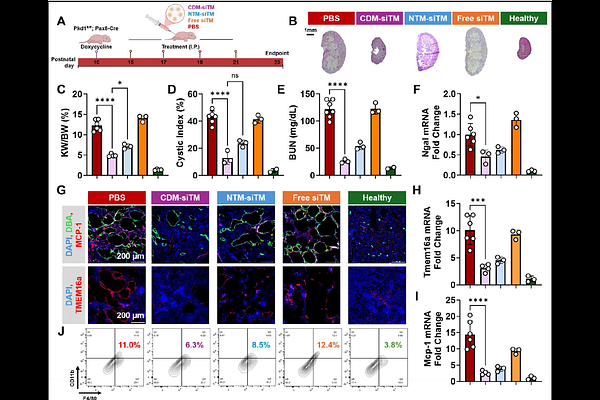
AbstractAutosomal dominant polycystic kidney disease (ADPKD) is the most common genetic kidney disease worldwide, characterized by progressive cyst growth and inflammation, yet effective targeted therapies remain limited. Here we show that TMEM16A and MCP-1, key mediators of cyst-lining epithelial expansion and inflammatory macrophage recruitment respectively, are consistently upregulated in cyst-lining collecting duct (CD) epithelia across murine, porcine, and human ADPKD models. In human ADPKD patient cells, although individual silencing of TMEM16A or MCP-1 transcripts reduced cyst growth, combined silencing produced superior therapeutic efficacy, establishing the rationale for evaluating dual-target delivery. To achieve dual gene silencing in the kidneys, we delivered Tmem16a and Mcp-1 siRNA using peptide amphiphile micelles (PAMs), an ultrasmall nanoparticle platform that enables efficient renal targeting. To redirect siRNA-loaded PAMs to CD epithelia, we functionalized their surface with a CD-targeting peptide (CDM), which enabled preferential accumulation in cyst-lining CD epithelia. In an inducible Pkd1-deficient mouse model, co-delivery of CDMs loaded with Tmem16a and Mcp-1 siRNA reduced kidney enlargement, cystic burden, tubular injury, and macrophage infiltration, with efficacy exceeding non-targeted siRNA delivery at equivalent doses. CDM demonstrated enhanced uptake in primary human ADPKD patient-derived CD cells and dual gene silencing reduced target gene expression and cyst expansion, establishing translational relevance. These findings establish CD peptide-functionalized micelles as a route to cell-type-selective RNAi in the kidney, delivering siRNA to cyst-lining CD cells. Furthermore, because both targets, TMEM16A and MCP-1, are transcribed within CD cells, our siRNA-loaded CD-targeting micelles silence two drivers of cyst expansion, and their simultaneous suppression represents an effective therapeutic strategy for ADPKD.