Integrin beta 1 and mannose receptor 2 are involved in the antifungal activity of bronchial epithelial cells through Aspergillus fumigatus lectin FleA interactions

Integrin beta 1 and mannose receptor 2 are involved in the antifungal activity of bronchial epithelial cells through Aspergillus fumigatus lectin FleA interactions
Millet, N.; Moreau, A.; Tarizzo, M.; Marti, L.; Varrot, A.; Gillon, E.; Richard, N.; Pionneau, C.; Chardonnet, S.; Varet, H.; Morichon, R.; Guitard, J.; Guillot, L.; Balloy, V.; Bigot, J.
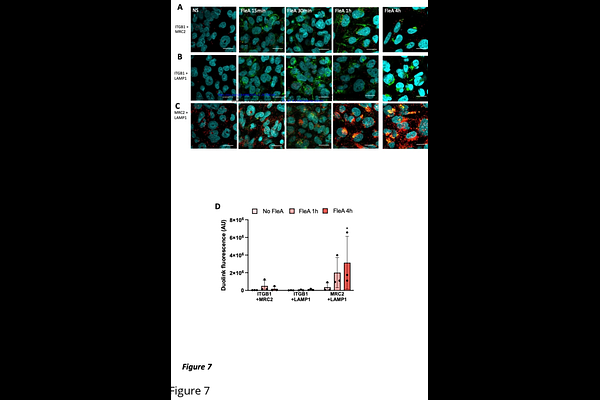
AbstractAspergillus fumigatus is a world-wide saprophyte filamentous fungus which released conidia, its infectious morphotype, in the atmosphere. These conidia are inhaled daily by humans and can colonize the respiratory tract, where they may develop into hyphae, the invasive morphotype. We previously showed that bronchial epithelial cells (BECs) restrict A. fumigatus virulence by inhibiting conidial germination and filament formation through a process requiring PI3K signaling and the conidial fucose-specific lectin FleA. In the present study, we are looking to identify host factors and cellular partners involved in the BEC antifungal response and to define the molecular interactions underpinning FleA recognition. For this, we analyzed transcriptome of BECs infected with A. fumigatus in the presence or absence of the PI3K inhibitor LY294002. Functional involvement of candidate genes was assessed by siRNA knockdown and readouts of fungal filamentation (microscopic scoring and galactomannan release). FleA-interacting host proteins were identified by biotin-FleA affinity co-precipitation coupled to Tandem mass spectrometry, and validated by surface plasmon resonance and biolayer interferometry. The spatiotemporal dynamics of FleA and candidate partners were analyzed by confocal microscopy and proximity ligation assay. We demonstrated that BEC antifungal activity involves at least two complementary pathways: a PI3K/laminin-332 axis promoting conidial adhesion, and a FleA-dependent pathway engaging ITGB1 and MRC2 consistent with lectin uptake and trafficking toward LAMP1-positive compartments. These findings nominate FleA-host receptor interactions as attractive targets for anti-adhesive strategies against A. fumigatus.