Recalibrating Nanoparticle Protein Corona Analysis for Accurate Biological Identity and Soluble Plasma Proteome Profiling

Recalibrating Nanoparticle Protein Corona Analysis for Accurate Biological Identity and Soluble Plasma Proteome Profiling
Ghaffari, B.; Grumelot, S.; Sadeghi, S. A.; Alpaydin, A.; Hilsen, K.; Shango, B.; Ritz, D.; Schmidt, A.; Vali, H.; Sun, L.; Saei, A. A.; Borhan, B.; Mahmoudi, M.
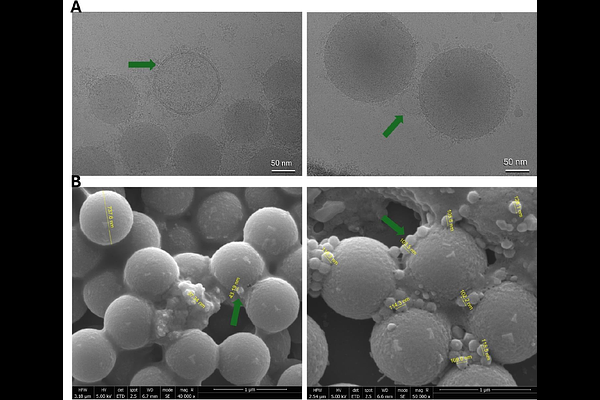
AbstractAccurate characterization of the nanoparticle (NP) protein corona is essential for predicting biological fate, safety, and therapeutic efficacy, and for enabling robust biomarker discovery. Standard isolation techniques, most commonly centrifugation and magnetic separation, are widely used, yet they rarely account for co-isolating endogenous biological NPs such as extracellular vesicles (EVs). This oversight can distort the apparent "biological identity" of the NP. Here, we quantitatively demonstrate the magnitude and impact of EVs on the perceived protein corona composition. We incubated highly monodisperse polystyrene NPs (50-1000 nm) and superparamagnetic beads in either standard human plasma or plasma depleted of EVs by immunoaffinity capture targeting 37 EV surface epitopes. Mass spectrometry revealed that EV depletion reduced the number of proteins identified on polystyrene NPs by 60-75% and on magnetic beads by 45-50%. Importantly, EV depletion also altered the apparent abundance hierarchy; it restored the expected relative abundance and rank of major plasma proteins such as albumin and shifted the top-ranked proteins from intracellular cytoskeletal component, consistent with EV carryover, to genuine soluble plasma adsorbates (e.g., apolipoproteins, complement factors). These results highlight that standard corona workflows can inadvertently co-isolate a vast array of EV-associated proteins, yielding inaccurate proteomic profiles. Discriminating genuine corona proteins and EV-associated contaminants is critical for advancing nanomedicine, ensuring predictive safety and efficacy profiles, and enhancing the precision of NP-based biomarker discovery.