PROPEL: a high-throughput shear-stress platform reveals organotypic thresholds in endothelial mechano-adaptation

PROPEL: a high-throughput shear-stress platform reveals organotypic thresholds in endothelial mechano-adaptation
Ching, T.; Teo, J.; Wangsrikhun, W.; Song, X.; Chen, C. S.
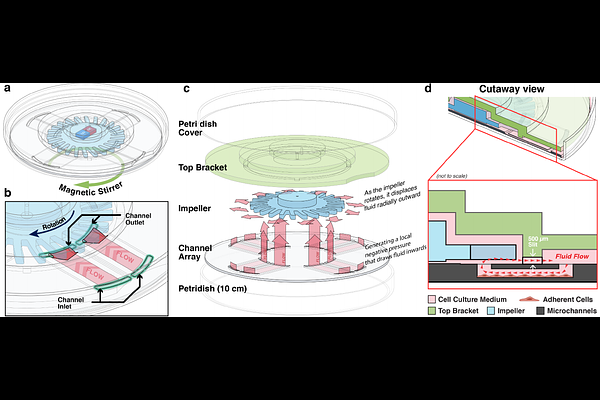
AbstractEndothelial cells exhibit organotypic specialization, yet the tools to decode whether hemodynamic shear shapes this diversity across vascular beds have remained limited. Here we present PROPEL, a tubing-free, magnetic stirrer-driven platform that delivers programmable laminar shear stress (2 to 60 dyn/cm2) to multiple cell types in parallel within the confines of a standard Petri dish, with the modular flexibility to easily introduce different substrate geometries including 3D vessel formats. Using this platform, we profiled six human endothelial subtypes across static, low, intermediate, and high shear. Phenotypic profiling revealed subtype-specific thresholds for alignment, elongation, and Golgi-nuclear polarization, including a dissociation between elongation and polarization in dermal microvascular and saphenous venous endothelial cells at low shear. Bulk RNA sequencing showed conserved transcriptional programs that shift progressively with shear magnitude, including induction of mechanotransduction pathways alongside suppression of proliferative programs. Phenotype-informed transcriptional comparisons further linked alignment transitions to engagement of cytoskeletal and metabolic signatures. In addition to conserved responses, organotypic-specific responses were also observed. Together, these findings establish PROPEL as a scalable platform for multi-endothelial, multi-shear transcriptomic and phenotypic profiling, and reveal that endothelial cells engage shear adaptation along two organotypic axes - a threshold axis governing when a subtype responds and a signature axis governing which the shear stress response - with implications for vascular bed-specific disease susceptibility.