Introgression from the wild relative Manihot glaziovii on cassava (M. esculenta) chromosome 1 exhibits segregation distortion and no direct effect on dry matter

Introgression from the wild relative Manihot glaziovii on cassava (M. esculenta) chromosome 1 exhibits segregation distortion and no direct effect on dry matter
Villwock, S. S. C.; Rabbi, I. Y.; Ikpan, A. S.; Ogunpaimo, K.; Nafiu, K.; Kayondo, S. I.; Wolfe, M.; Jannink, J.-L.
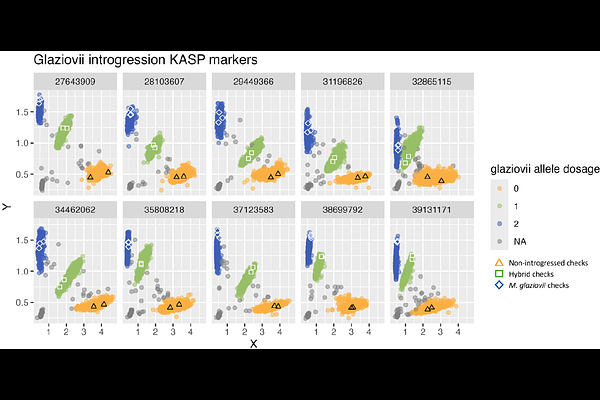
AbstractThe cassava (Manihot esculenta) genome has two large introgressions from its wild relative M. glaziovii on chromosomes 1 and 4 that originate from historical hybridization efforts. The 10 Mbp chromosome 1 introgression has been increasing in frequency in African breeding populations due to its statistical association with higher dry matter content and root number. However, the region also exhibits suppressed recombination, hindering breeders' ability to combine favorable glaziovii alleles with the cultivated esculenta background. Since homozygous introgressed lines are rarely selected for advanced trials, dominance effects have not been well-characterized. To analyze the effects of the introgression with higher resolution, we generated a population of over 5000 seedlings from crosses between heterozygous introgressed parents and screened for recombinants using ten KASP markers tagging glaziovii-specific alleles. An optimized subset of 453 lines was then selected and evaluated over two years for yield and vigor traits. Unlike previous studies, composite interval mapping and mixed linear models showed no significant associations between glaziovii alleles and dry matter content or root number. Small, opposing effects on clonal vigor were observed at different ends of the introgression. The region showed significant segregation distortion and enrichment of putative deleterious alleles. Genome alignment of M. esculenta and M. glaziovii assemblies did not show any major structural variants in the introgression region, suggesting that suppressed recombination is likely driven by sequence-level divergence rather than structural rearrangements. These results indicate that the glaziovii introgression does not directly contribute to dry matter, supporting the need for recombination and purging of the glaziovii introgression to aid cassava improvement.