Hippocampal patterns and associative memory: Distinct intracranial EEG temporal encoding patterns support memory

Hippocampal patterns and associative memory: Distinct intracranial EEG temporal encoding patterns support memory
Xue, A. M.; Hsu, S.; LaRocque, K. F.; Raccah, O. M.; Gonzalez, A.; Parvizi, J.; Wagner, A. D.
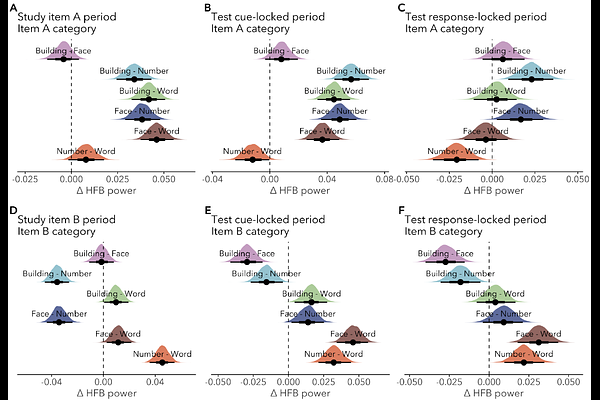
AbstractEpisodic memory depends on neural representations encoded in the hippocampus. Experimental and computational evidence suggests that the hippocampus encodes pattern-separated representations that support later recall of episodic event elements. While extant data in humans predominantly focus on assaying the relationship between the similarity of spatial neural patterns at encoding and later memory performance, similarity of neural patterns in the temporal domain may also reveal encoding computations predictive of future memory. To examine how the similarity among temporal patterns of hippocampal activity during encoding relates to later episodic retrieval (associative cued recall and recognition memory), hippocampal activity was recorded from human participants (n=7) with implanted intracranial electrodes while they encoded arbitrary (A-B) paired-associates. Subsequent memory analyses first revealed that hippocampal high-frequency broadband power (HFB; 70-180Hz) was linked to a graded increase in memory strength; HFB power was greater during the encoding of pairs later correctly recalled relative to events later recognized and was lowest for events later forgotten. Second, and critically, subsequent memory analyses further revealed that more distinctive temporal patterns in the hippocampus during encoding - indexed by the similarity of the HFB timeseries elicited by a given event to that elicited by other events - were associated with superior subsequent memory performance. Finally, exploratory analyses revealed stimulus category effects on hippocampal HFB power during encoding and retrieval cuing. These results indicate that the temporal distinctiveness of hippocampal traces during encoding is important for subsequent retrieval of episodic event elements, consistent with theories that posit that pattern separation facilitates future remembering.