The genome of the avian malaria parasite Haemoproteus majoris (lineage WW2) and its relationship to other Plasmodium species

The genome of the avian malaria parasite Haemoproteus majoris (lineage WW2) and its relationship to other Plasmodium species
Bardil, A.; Berthomieu, A.; Dainat, J.; Fontaine, M. C.; Hellgren, O.; Rivero, A.; Otto, T. D.; Gandon, S.
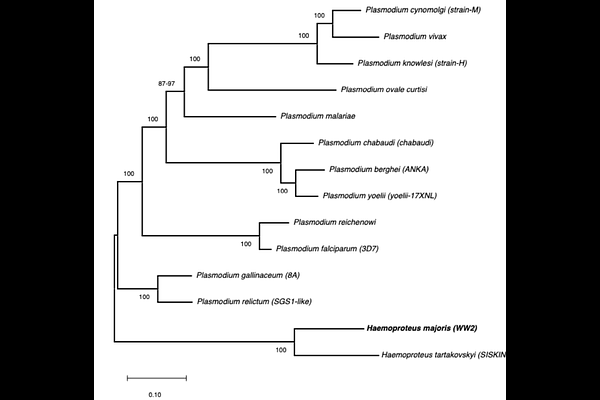
AbstractAvian malaria parasites form a highly prevalent and genetically diverse group within the haemosporidians, yet they have long been overlooked relative to their human- and rodent-infecting counterparts. Among these, parasites of the genus Haemoproteus (Haemosporida, Haemoproteidae) are widespread and prevalent blood parasites of birds, transmitted by louse flies (Hippoboscidae) and biting midges (Ceratopogonidae). Recent phylogenomic analyses place Haemoproteus parasites at the root of the haemosporidian tree, making genomic data from these taxa essential for understanding the evolutionary origins of malaria parasites. To date, only two avian Plasmodium and one avian Haemoproteus genomes have been sequenced. We present the first assembled genome of Haemoproteus majoris (lineage WW2), a common blood parasite of passerine birds. As avian erythrocytes are nucleated, parasite DNA was enriched by FACS-based sorting to discriminate and isolate the parasite from host cell nuclei prior to whole-genome amplification. The genome was assembled using Nanopore long-read sequencing and polished with Illumina short-reads, yielding 145 contigs with a total assembly size of 23.9Mb and a G+C content of 27.85%. Genome annotation identified 5501 protein-coding genes, 69 non-coding RNA genes, and 57 long terminal repeat retrotransposons (LRT-RTs), including one full-length element. This genomic resource represents a critical step towards elucidating the evolutionary history and genomic architecture of avian malaria parasites.